Sunday, July 05, 2009
Saturday, September 01, 2007
The Colt Model 1908 In .380 ACP Has Risen From The Waste Pile
Last September I bought myself a handgun as a birthday present since this was a tradition I started when I turned 21. Now, don’t get me wrong—while this is a tradition I have not been able to adhere to it every year. I think I started this tradition due to the fact that no family member or friend would likely buy me a handgun so I took it upon myself to do so the very day I was old enough.
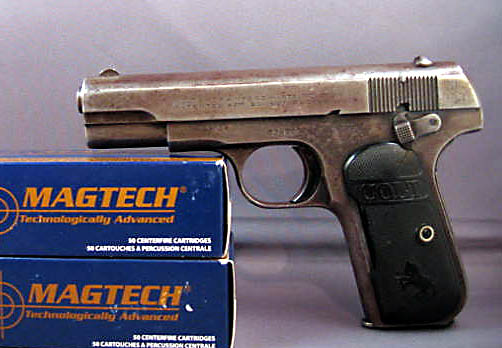
Last year I purchased a Colt Model 1908 Pocket Hammerless pistol in pretty much junk condition. I already have three examples of Colt’s Pocket Hammerless; one in each caliber Colt offered (.25 ACP, .32 ACP, and .380 ACP). I love this design and the history associated with this pistol, but I do not shoot them often due to their collector status. My birthday present was certainly not in collect condition so there was no need to keep it in its original state. I have long wanted to correct one of the glaring defects common to pistols of this era which is their almost nonexistent sights. Now there could be several reasons for this phenomenon. First of all long range handgun shooting did not gain much popularity until after WWII; so at the turn of the century (the last one, not the current one) handgun shooting was seen as a close range defensive art. Secondly, small semi-automatic pistols were seen as pocket guns. Men’s trouser and coat pockets were larger and suits were baggier so these thin, flat pistols were a natural to be slipped into a pants pocket, suit jacket pocket, overcoat pocket, or, in the case of the Model 1908 in .25ACP, a vest pocket. Thus, large sights would snag on the pocket and become a liability. The condition of this junker would allow me make any modifications I desired to pay for.
History Refresher
The Colt Pocket Hammerless is another design by firearms genius John Moses Browning (one of these days I must pick up a biography on him). The story goes that he presented the design for this pistol to Colt Management in 1899 and they weren’t that interested as they were busy trying to produce a new larger caliber pistol which would win them another military contract. Short sighted American firearms manufacturers made the mistake of turning down Browning designs on several occasions. When they did, Fabrique Nationale d’Armes de Guerre of Belgium was always ready to welcome Browning. While Colt toiled away on a military sidearm Fabrique Nationale produced Browning’s self loading pocket pistol as the FN Model 100. In a relatively short period of time Colt found that their civilian sales in Europe were drying up as the market was in love with the FN-Browning pocket gun. Colt also realized that American retailers were beginning to import this pistol in fairly large quantities. Colt quickly brokered a deal with Browning and Fabrique Nationale to be able to produce the handgun for U.S. sales. On June 19, 1903 Colt began shipping out their new Model 1903 Pocket Hammerless in .32 ACP. Five years later they also released the Model 1908 in .380 ACP and a smaller (vest pocket) version in .25 ACP. The Pocket Hammerless was vastly popular and by the time production ceased after WWII Colt had manufactured over one million of these pistols. Unfortunately, quality became the demise of the Pocket Hammerless. By the end of WWII, Colt’s machinery was worn out and the staff made these pistols was retiring. The Pocket Hammerless was a “tight” pistol which required a fair amount of hand fitting. The reinvestment in the equipment and personnel required to make the model 1903 and 1908 would raise the cost of making the handgun beyond the reach of their customer base so it was discontinued.
The Pocket Hammerless has had a storied past in terms of who utilized the pistol. Many were privately purchased during WWI and slipped into the trench coats of the American Expeditionary Forces. By WWII they were standard issue to General Officers in all branches of the military and used in moderate numbers by the Office of Strategic Services, the fore runner to the CIA. Their issuance to General Officers continued through the Vietnam Conflict.
The Pocket Hammerless was also popular with the gangster contingent as well. Al Capone was said to have kept one in his night stand. John Dillinger owned several of them.


Upon buying the “project” Model 1908 it was apparent that it needed more than new sights. The finish was completely worn off and the gun sported a sickly brown patina with spots of pitting in several areas. The grips were cracked and chipped. The Safety spun like a top and the recoil spring was more crooked than a Democratic presidential front-runner.
Friday, November 24, 2006

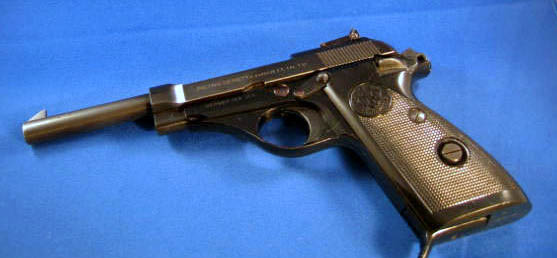
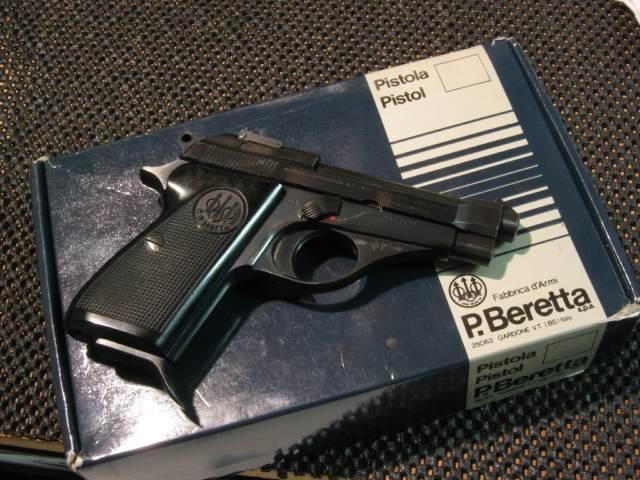
Not much is known about this pistol. I can find no information on the internet or in any of my reference books. Obviously it is a modified Model 70 which Beretta produced in .22 Long Rifle, 7.65mm (.32 ACP), and 9mm Short (.380 ACP).

(Beretta Model 70)
The Model 70 was the company’s replacement for the .32 ACP and .380 ACP models 1934 and 1935 which was the standard police and military arm from the mid-1930’s through the end of World War II.

(Beretta Model 1934)
The Model 70 was also purchased in great quantities by the Mossad, the Israeli Secret Service. They favored the .22 Long Rifle version as an assasination weapon because it was flat and easy to conceal, accurate, and had a low report when fired. The model 70 was manufactured from 1958 through 1985 and replaced by the model 84, 85, and 87.
The Model 100 is obviously a target version of the Model 70. The differences are the much longer 5.9 inch barrel, adjustable target sights, and longer grip frame. The magazine holds 9 rounds with one in the chamber giving the shooter a total of ten rounds. The magazine curiously also contains a finger extension which, due to the longer grip frame, is totally unnecessary. The grips are wrap-around plastic and are fine for their intended purpose. A set of contoured rubber replacement grip panels would be great, however rubber grips for this pistol and the Model 70 are not catalogued by any manufacturer and it is doubtful they ever were.
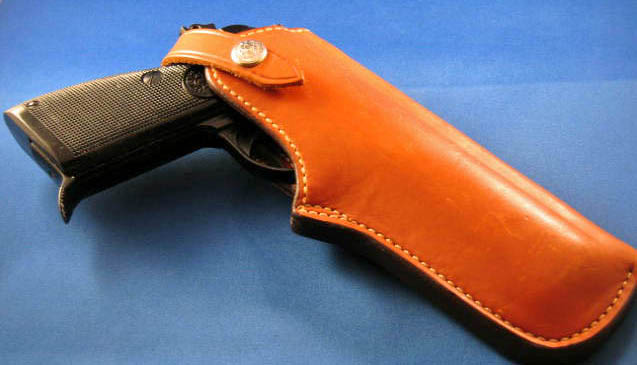
(Model 100 in a Bianci #39 holster)The Model 100 is a single action only with a slide safety on the left side of the frame right where you would want it to be. This is a very light weight aluminum framed pistol and dispite the length of the pistol it would be very easy to carry for extended periods. The Model 70 as well as this Model 100 began Beretta’s departure from the traditional European style heal mounted magazine release. The mag release on the Models 70 and 100 are on the left lower portion of the grip and look like the head of a large screw. While it is better than the heal mounted release, it does not have the ergonomic placement that John Browning designed for the Colt Model 1911 .45 semi-automatic pistol.
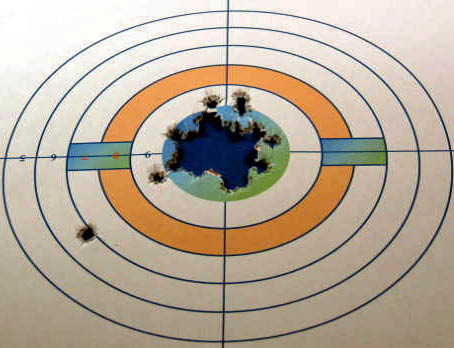
The Model 100 does offer good accuracy to which these 6.5 inch targets attest although I seemed to have a habit of throwing the first round low and to the left. The accuracy was assisted by the short, crisp trigger pull. All targets were all fired at 21 feet.


The .32 ACP is not a very powerful round for self defense although European military and police departments used it as such well into the 1970’s. This Model 100 did not care for Winchester Silvertips but did feed hollowpoints from Speer (Gold Dot) and (Federal Hydra Shok). While scoring low on the “Power Meter” the pistol does score very high on the “Coolness Meter”. The pistol has an exotic appearance and one can easily imagine James Bond going up against one of his fictional villains brandishing a Beretta 100.
Updated Information
Subsequent to the posting of this information I learned that the Model 70 was restricted from importation after the Gun Control Act of 1968. The GCA attempted to ban all imported handguns which were small enough for concealed carry. To get around this Beretta added the longer barrel, adjustable sights, and lengthened the grip frame to create the target configuration of the model 100. This allowed the Beretta to once again export the .32 ACP pistol into the U.S. Unfortunately, the model 100 did not turn out to be a huge seller.
Sunday, September 24, 2006
I have always wanted to have a pistol, customized to my specifications, however most custom pistols and revolvers begin at close to $3 grand and go up. But now I have seized the opportunity to do one that I will really like, for a fraction of the price. How you ask? Well the pistol that I am starting with was handfit at the Colt factory before Colt discontinued making them in 1945. Therefore extensive hand-tuning doesn't need to be done. Well then, a discontinued Colt, especially one that was handfit at the factory would be rather costly, right? Well yes. In fairly good condition they run about $500. Add to the fact that the caliber I was looking for was only produced in small numbers and that would push it to around $700. In great condition a they run close to a grand and special engraving or military marked models will propel the price close to the $3 grand mark again. But this one was very cheap because it was in pretty lousy shape. Have you figured out what I am talking about? It is a Colt Pocket Hammerless in .380 ACP. This one is in bare bones condition, which is just what you would want if you are going to customize. I already own 2 of them; one in .32 ACP, the Model 1903, and one in .380 ACP, the Model 1908. However, they are in such good condition that they have too much collector value to mess with them. The one I just purchased doesn't have much collector value...yet.
As you can see, this one doesn't have a patch of original bluing left on it and has developed gray-brown patina. The left grip panel has a huge chip out of it and a long, wide crack. The slide safety is so loose that the wind could blow it 180 degrees if the grip wasn't there.So, some of the modifications are pretty obvious. 1. The pistol needs to be reblued. 2. The slide safety needs to be replaced. 3. The grips need to be replaced (and while new replacement grips have been manufactured from the originaly Colt castings, the gunsmith that will be doing the work has a set of vintage J. Scott Mother-of-Pearl grips that will set this piece off beautifully). 4. The recoil spring needs to be replaced (since the serial number puts this pistol as having a manufacturing date of 1922, it's probably time to change the spring). The real customization of this piece will be new sights. As was the fashion at the time, these pistols were made with what can only be politely described as "nominal" sights. This is one of the most perfect pistols ever produced, the only things wrong are the minimal sights and the fact that the magazine release is on the heal of the grip instead the 1911 type button release just behind the trigger on the left grip frame. The gunsmith showed me a set of low profile 1911 3-dot sights that will do nicely. As for the magazine release...I'll live with it where it is. To have it removed and a 1911 style rebuilt into the grip frame would cost too much and I have only seen one Colt Pocket Hammerless (in a magazine) with that modification. The last piece that we were looking at replacing is the barrel. While the rifling in this barrel is very good, there is some erosion and what appears to be a slight ring about a third of the way up from the chamber. Not to worry, plenty of replacement barrels are out there.
I then shot the pistol so see if it functioned OK. The pistol functioned flawlessly. I put 100 rounds through it with no problems.

And...the accuracy is top notch as shown in these targets which were set at 21 feet. 25 rounds were fired at each target. The accuracy is so good that the original barrel is staying; erosion, barrel ring and all. If it ain't broke, don't fix it. These targets are not bad for an 84 year old pistol in poor shape with almost non-existant sights! This is a true testiment to the genius of John M. Browning's design and the manufacturing standards that Colt used to have.
So stay tuned! These are the "before" shots and I can't wait to show you the "after" photos.
Monday, September 04, 2006
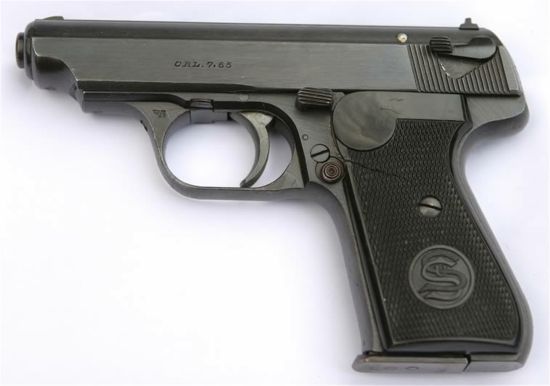
The JP Sauer & Son Model 38H is a 7.65 mm (.32 ACP) caliber fixed barrel blowback operated semi-automatic pistol with a magazine capacity of 8 rounds. While rather plain and unremarkable looking it contained all of the bells and whistles available at that time and one refinement that has never been seen since.Sauer & Son were in stiff competition with Mauser and Walther in the small pocket-pistol market when they developed the Model 38H. At the outset of WWII the pistol was issued to German police units as well as some 200,000 being ordered for the Wehrmacht (Army) and Luftwaffe (Air Force).
The pistol has the rudimentary small front blade sight and U-shaped rear sight that were very common for the time of manufacture. The safety lever is mounted on the left rear of the slide. The 38H has a loaded chamber indicator in the form of a pin which sticks out at the rear of the slide when a round had been loaded. There is a frame-mounted magazine release button on the left side just to the lower right of the trigger guard and this is somewhat unusual for a European pistol at this time as most employed a magazine catch on the heal of the grip. Now for the real innovation. The Sauer 38H was the first pistol to have a decocker lever which is mounted on the left side just in front of the grip. While decocking levers have become somewhat standard, especially on the SIG-Sauer pistols (the firm that Sauer & Son eventually merged into), this one was the first and...not only is it a decocker, but it is also a recocker. This pistol offered the owner a lot of options. It could be carried cocked and locked in the single action mode. It could be decocked and carried in the traditional double action mode (double action for the first shot and single action for the remaining rounds). And finally, it could be carried decocked in the double action mode and recocked into the single action mode before firing. As the War rolled on Sauer eventually eliminated the safety level as it was rather redundent and late in the War they removed the decocking lever as well.
The Sauer Model 38H was supposedly favored by the paratroop units of the Luftwaffe for its small size. As German troops carried their pistols in cross-draw holsters one can certainly imagine that a large Walther P-38 Service Pistol or Luger P-08 could be quite uncomfortable as the paratroopers made their landing. However, what does not make a lot of sense here is that upon landing the Sauer 38H was the only firearm to which the paratrooper had immediate access. Unlike the Allied airborne troops the Luftwaffe paratroopers jumped into occupied territory without their primary weapon. Their Mauser 98 bolt action rifles and MP40 submachine guns were dropped seperately in special containers. So upon landing, until they could find the weapons container, the German Paratrooper was armed with a .32 caliber pistol with one spare magazine for a total of 16 rounds. This may account for the fact that I have never heard any tales of daring deeds accomplished by the Luftwaffe Paratroop Corps. OK...they rescued Mussolini after being overthrown, but by then the Italian army's tactical emphasis was on surrendering to Allied troops so I am not sure it was much of an accomplishment.
So how effective was the pistol that the Luftwaffe hit the ground with?

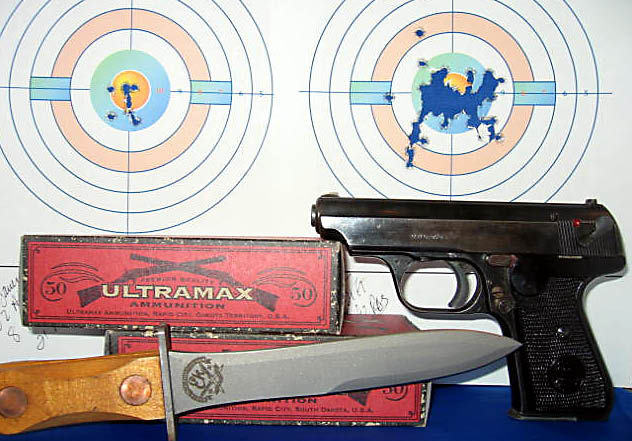
Well, my specimen had plenty of accuracy. (click photo to enlarge)
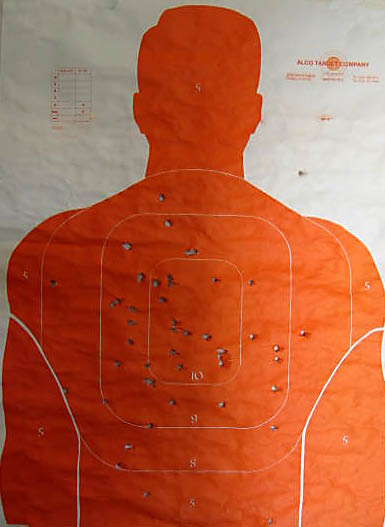
Show here are two targets placed at 21 feet. (Also shown is an Ek commando knife.) The target on the left was fired at with a full magazine of 8 rounds while the target on the right took 42 rounds. This shows plenty of accuracy for normal defensive encounters in an urban environment, but this was war! How good was this pistol at any distance? Well the next target was placed at 25 yards (75 feet) to see how the 38H would perform.

I fired a full box (50 rounds) of 71 grain FMJ bullets at this target with only one flyer going above the right shoulder. The other 49 rounds hit home with the majority of them landing in the 9 and 10 ring.
While the accuracy is pretty darn good for a pocket pistol the .32 jacketed bullets are not really all that potent. Fortunately my pistol also handled hollowpoints (Winchester Silvertips and Federal Hyda-Shok bullets) without a problem. In fact, there were no malfunctions in the 200+ rounds I put through this pistol.
Tuesday, August 01, 2006

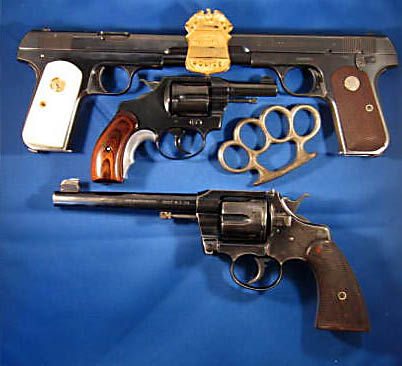
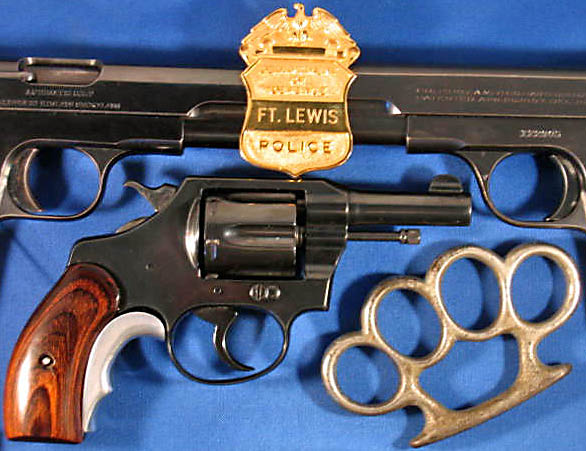
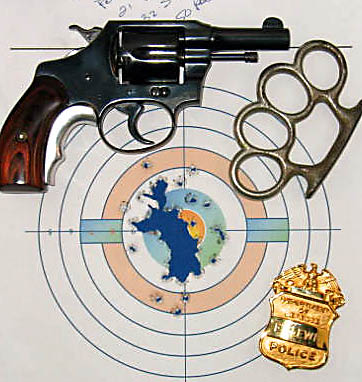
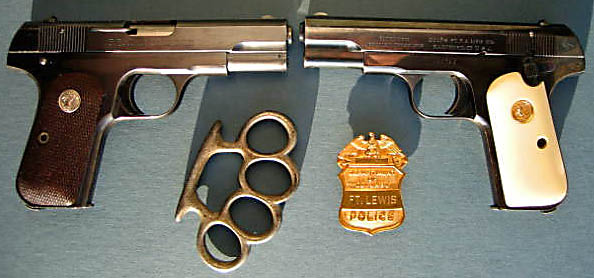
From left: Model 1903 in .32 ACP (sporting faux ivory grips), Pocket Positive Revolver in .32 Colt Police (.32 S&W Long), Model 1908 in .380 ACP and (bottom) Officer's Match in .38 Special. Also pictured is a vintage Fort Lewis Police, Department of Defense badge and Grandpa's brass knuckles. (click to enlarge photo)
The Colt Model M pocket pistos were manufactured from 1903 (in caliber .32 ACP ) and 1908 (in caliber .380 ACP) until 1947. Production continued through World War II with the US Army issuing both the .32 and .380 pistols to General officers. Eisenhower, Patton, and Omar Bradley were all issued a Colt Model M pistols with Patton receiving one in each caliber. At the end of their service the officers were allowed to purchase their pistol, belt and holster. This practice continued through the Vietnam War. These pistols were extremely popular with almost one million produced, about three-quarters being calibered in .32 ACP.
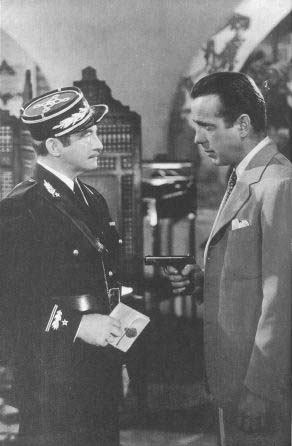
They were also used in many Hollywood movies of the 1930's and 40's. In fact Hollywood liked to use both the .32 semi-automatic pistol and .32 caliber revolvers for several reasons:
- .32 ACP blank ammunition was more reliable than .45 ACP ammo.
- The smaller caliber ammunition produced less of a report than a .45, .44, or .38 Special so they were less of a problem for the sound engineers who did not have the sophisticated digital recording equipment of today.
- The final reasons were that the smaller caliber guns made their movie stars look more imposing. The recoil of a .32 was very manageable when shooting one-handed and a .32 auto pistol or revolver was smaller than a full sized .45 auto or .38 revolver so the forced-perspective of a smaller handgun made the actor look bigger.
Humphrey Bogart pointing a Colt Pocket Pistol at Claude Rains in Casablanca.
(click to enlarge photo)
So the next time you are watching a gangster film with Bogart, Cagney, Muni, Garfield, or Robinson take a close look at the heat they are packin'. It might be a .32.
But don't limit your scrutiny to vintage cinema, in 1997's L.A. Confidential corrupt police captain Dudley Smith produced a Colt Model 1903 .32 ACP from the pocket of his bathrobe and used it to dispatch Detective Sgt. "Hollywood" Jack Vincennes.
Captain Dudley Smith fires a .32 ACP from his Colt Model 1903 Pocket Pistol at point blank range into the heart of Sgt. Jack Vincennes.
This scene was preceeded by one of my favorite movie lines. Sgt. Vincennes comes to Captain Smith's house in the middle of the night to discuss the possibility of police corruption whereupon Captain Smith says "Don't start tryin' to do the right thing now Jack, you haven't had the practice".
Shooting the Model M pistols
Model 1903 in .32 ACP
The serial number of this pistol puts it's date of manufacture as 1912. This pistol is just 6 years shy of it's 100th birthday and the only thing that has been replaced have been the grips. The barrel, springs, magazine and finish are all original.
The finish is probably 90% and still maintains some of the famous bright blue luster that Colt used to be able to put on their firearms.
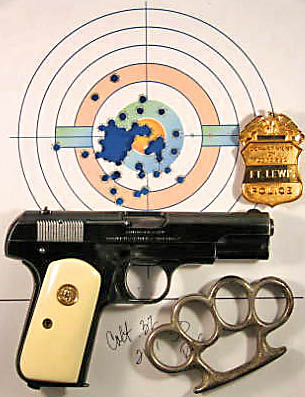
50 rounds of .32 ACP ammunition fired at 21 feet.
(click to enlarge photo)
This pistol is easy to shoot. The recoil is almost non-existant and the old girl still has plenty of accuracy left in her. Due to the popularity of these pistols spare parts (both old and newly manufactured) are available. It is not difficult to find original and aftermarket grips, and newly made springs, magazines and barrels. The one complaint I have with these pistols (and most pistols of this era) is their sights. These pistols were not intended as target guns or for anything other than close quarters shooting, but better sights would be great for these old eyes. With all of that being said, she shot pretty good at 21 feet. Originally this pistol would not feed hollowpoint ammunition. After my last session I polished the feedramp with 000 steel wool. On this trip to the range both Winchester Silvertip and Federal Hydra-Shok ammo fed with no malfunctions.
Model 1908 in .380 ACP
49 rounds of .380 ACP ammunition fired at 21 feet
(click to enlarge photo)
The serial number of this pistol puts its date of manufacture as 1935. Again, this pistol is in all original condition, including original grips. The finish is also about 90% but is almost black in color. The .380 ACP cartridge had a more robust recoil than the .32 and caused the checkered thumb safety to eat into my right thumb. This is probably partially due to the well-worn walnut grips. The checkering on the grips is still visible, but they are fairly worn down with age bringing the thumb in closer proximity to the safety lever. A new pair of aftermarket grips would undoubtedly solve this issue. Again, practical accuracy within intended ranges is certainly pretty good.
I would love to find a "junker" Colt .380 ACP (that has no collector value) and have it refinished and updated with better sights. These are fantastic handguns produced by a premier factory at the height of their art. All parts of these pistols were hand fitted and the amount of time and craftmanship that went into the production of these pistols would render them impossible to produce in today's world.
Colt Pocket Positive
The Colt Pocket Positive was produced in .32 Colt Police (interchangable with the .32 S&W Long cartridge) with a 98 grain round-nose bullet. The Smith & Wesson cartridge pushed the bullet a little faster than the Colt round so the S&W cartridge survived and the Colt round is relegated to curio status.
I have written about this pistol before and was not really impressed at the accuracy. Since then I completely scrubbed the barrel, bringing back the prominence of the rifling, and added a Tyler T-Grip adapter to the aftermarket grips that were already on the piece. Firing yesterday I was still not happy with the accuracy until I tried backing some of my trigger finger off the trigger. It is a little difficult to see, but this is a very small revolver and it is too easy to get too much finger on the trigger and...Bingo that's all she needed! 
Here's 50 rounds of .32 S&W Long fired at 21 feet and that's about all the accuracy that could be expected from this little piece. Now I am very happy with it's performance. If your life was threatened, this little revolver, loaded with Mag-Tech 98 grain semi-jacketed hollow point ammunition, would be better than a poke in the eye with a sharp stick. (Although come to think of it...a poke in the eye with a sharp stick is pretty effective too.)
Colt Officer's Match in .38 Special
I have written about this old shooter before. I don't have much to say except that I am very happy with the way she performs. Here's fifty rounds fired at 30 feet.
Conclusion
In this range report we looked at four Colt handguns all produced well before WWII. So what's the morale? These old timers are still useful and the next time you see one in your dealer's show case or at a gun show, give 'em a look...or don't and it will still be there when I come in.
Wednesday, July 19, 2006

(click to enlarge picture)
Colt Police Positive in .32 Colt with "Angel Wing" Folding Knife by Gene Osborn.
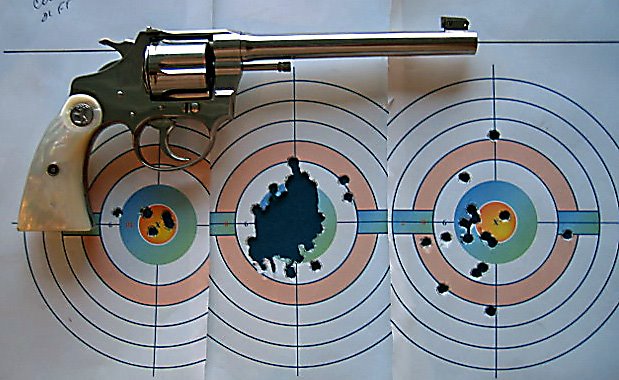
This is a Colt Police Positive .32 Colt Target Model, nickle plated, in 95 to 98% original condition with a six inch barrel, windage adjustable rear sight, elevation adjustable front sight, and original Colt mother of pearl grips. The backstrap, trigger and hammer are all neatly checkered. The folding knife was crafted by artisan Gene Osborn of Center Cross Cutlery (www.centercross.com) and features an ATS-34 Hollow ground stainless steel blade on an extended tang lockback folder with mother of pearl handles, red expansion spacers and bronze damascus bolsters. The folder is fully fileworked and the titanium liners are multi colored.
Shooting the Police Positive

Left to Right: Six rounds was fired at the first target which was set at 21 feet. The second target was also set at 21 feet and absorbed 44 rounds. The last target was set at 40 feet and fired at with 16 rounds.
(Click photo to enlarge)
This Colt Police Positive is really a beautiful revolver and the Mother of Pearl grips are magnificent with streaks of red and blue visible when they catch the light. There is not a scratch, ding or piece flaking off. There is actually a swell in the center of the grips which had to have been difficult to execute by whoever fashioned these grips at Colt. Mother of Pearl just isn't that stable of a material and flakes, chips, and splinters quite easily. The grips were filling enough that I was not tempted to add a Tyler T-grip adapter to them as I have on most of my vintage revolvers. This revolver also had a beautiful trigger pull and begged to be fired double action. The DA pull was easy to stage (credit to Mike D. for teaching me that) and actually gave better accuracy in Double Action shooting than when firing Single Action. All shooting was done with Mag Tech 98 grain semi-jacketed hollow point ammunition. If Colt would go back to making revolvers with the same attention to detail and overall quality they would be in great demand.
Smith & Wesson Heritage in .44 Special

(click to enlarge picture)
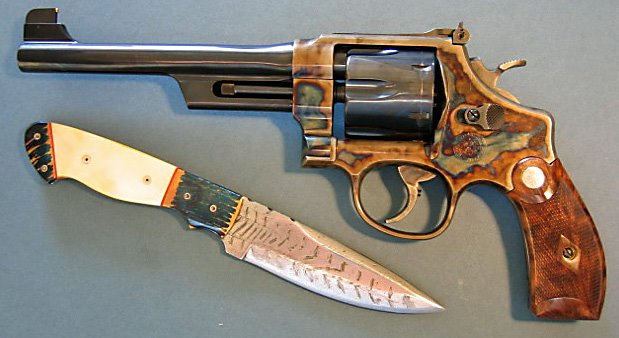
Smith & Wesson Heritage Revolver in .44 Special and "Devine Spirit" hunting knife by Gene Osborn.
The Smith & Wesson Heritage Series revolvers were made in the late 1990's and although some were exact copies of vintage S&W revolvers, this one is more of a blending of some of their older handguns. The .44 Special features a case colored frame with a blued barrel. The rear sight is adjustable for windage and elevation and the front sight is of the target variety with a gold bead. The gold bead picks up whatever light is available and this was the best sighting arrangement "back in the day' before fiber optic, glow-in-the dark, red dots and laser sighting systems. When I first saw the Smith & Wesson Heritage series advertised I wanted one, but never saw one in a gun shop. When the series was discontinued I gave up looking for one. As luck would have it, I just happened to be at a local gun shop right after someone brought a seemingly unfired specimen in to trade. It had not even been tagged for sale when I slammed down a layaway payment. The "Devine Spirit" hunting knife is another Gene Osborn creation and has gold-lip mother of pearl handles with red expansion spacers, Gene's own bronze cable Damacus bolsters (both front and rear), and a three billet composite cable damascus blade with opposite twists forged by Gene himself. The blade also has a false edge on top and filework on spine The Damascus is certainly unlike any I have ever seen, it almost looks antique. You will be hard pressed to find this Damascus steel in any other knife. The moniker "Devine Spirit" is the name I gave to this knife, not Gene. I call it "Devine Spirit" as a Japanese reference to the workmanship Gene has demonstrated in this knife. You see, the Japanese believe that a master bladesmith can put his spirit into the blade. They speak of the concept of a "live" blade. To many westerners who do not understand, they think that "live" merely means sharp. While it is sharp, "live", to the Japanese, it also infers that the spirit in the blade makes the blade alive and when the owner felt this he was bound by tradition to only use the blade in accordance with their code of honor.
Shooting the Heritage
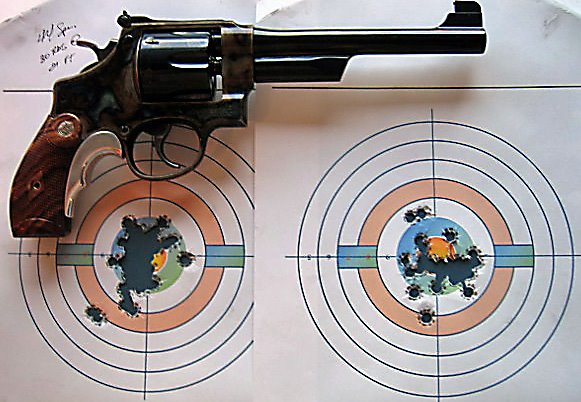
Two targets fired at 21 feet using Mag Tech 240 grain cartridges.
(click photo to enlarge picture)
Target on the left was fired at 40 feet, target on the right was set at 50 feet. Both targets where shot with CCI Blazer 246 grain Gold Dot Hollow Point ammunition.
(click on photo to enlarge image)
The Smith & Wesson Heritage model is another great shooter. The area between the front strap and the trigger guard was a little too wide so I added a Tyler T-grips adapter to assist the handling of this great looking revolver. The Single Action Trigger pull was extremely light. Having an accidental discharge would be quite easy and really brought home the importance of always keeping the barrel pointed downrange and keeping your finger off of the trigger until ready to fire. The good new was that the double action pull was very good and not a hinderance to accurate shooting. Another good lesson is to always check your ammunition closely. The night before this range session I stopped and picked up two boxes of .44 Special; a box of Mag Tech and a Box of Winchester 240 grain target loads. At the range when I got to the Winchester ammo I placed them into the cylinder and it would not shut. I realized that just a little bit of the cartride was not going into the cylinder chambers. Upon closer inspection the ammunition was .44 Magnum, rather than .44 Special. Checking the box again it was clearly marked .44 Special. I am very thankful that I did not try to force the cylinder closed while it contained the magnum ammunition. Smith & Wesson no longer makes the Heritage series of revolvers and I feel very fortunate to have found one.
Sunday, July 16, 2006
As most of you know, our shooting range was closed from December until the 3rd week of March, during which time new ownership took over. This left my normal Saturday morning shooting time wide-open. This allowed me the opportunity to peruse local gun shops and gun shows looking for vintage Colt and Smith & Wesson double-action revolvers. At first this search was very disappointing, not that the vintage models in acceptable to fine condition were not available, in fact they are. The problem that arose was price. If one was to find a good specimen of a Smith & Wesson triple-lock or a Colt New Service revolver, and I found many, you were generally looking at $800 to a grand for a shootable, but very used gun. Triple-locks and New Service revolvers with most of their original finish and sharp, uncracked grips ran in the neighborhood of $1200 to 2 grand. Finally another collector clued me in that, if I were to look at revolvers in some of the more unpopular calibers, acceptable pricing could be found. As I began to look, I found that vintage revolver in .22 Long Rifle, .38 Special, .44 Special, .44-40, .45 ACP, and .45 Long Colt commanded the highest prices. While revolvers in .32 S&W Long, .32 Colt Police, and .38 Smith & Wesson, tended to languish on dealer’s shelves and on gun show tables which brought their prices down.
That brings me to the three finds, two from gun shops and one from a gun show.
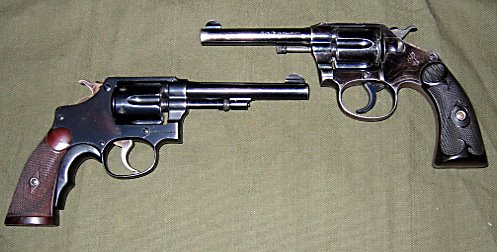
Let’s start with two revolvers. The Colt Police Positive in .32 Colt Police (upper right) and a Smith & Wesson Hand Ejector in .32 S&W Long (lower left):

Your first question might be what is the difference between the .32 Colt Police round and the .32 S&W Long cartridges? The answer is: Nothing. They are exactly the same round. Smith & Wesson developed the cartridge first and began marketing it for personal protection, small game, and law enforcement. Colt realized that they needed to catch up so that produced their own revolver, aimed at police sales and dubbed it the Police Positive in .32 Colt Police. It is unclear whether Colt was afraid of a lawsuit if they claimed to use the same round or if they did not want Smith & Wesson’s name in their advertisements, but the result is the same; the rounds are interchangeable.
Colt Police Positive
Both of these revolvers were born in the days before the beginning of the last century. The Police Positive was adopted by New York City Police Commissioner Theodore Roosevelt as standard issue to the NYPD. Prior to Roosevelt police officers supplied their own firearms in whatever caliber they wanted. Also, there were no formal firearms training standards. The story goes that Roosevelt decided to change all of this after two officers were trying to shoot a mad dog and wound up hitting quite a few civilian bystanders who came out to see what all the shooting was about. After quick research and testing Roosevelt settled on the Colt Police Positive in .32 Colt Police. He made his decision based upon his personal finding that the revolver was superior in the accuracy department.
I found this Police Positive collecting dust on the shelves of the Boise Gun Company for the princely sum of $179.00 (compared to a Colt New Service revolver in .38-40 caliber next to it with almost no original finish and priced at $900.00). It is difficult to see from the picture but the gun only retains about 50% of the original bluing and virtually none on the backstrap. While this specimen must have seen some pretty good use, the cylinders locked up tight and the bore was in excellent condition. The small front sight is very thin and the rear sight very narrow and shallow. I was concerned about the ability to accurately and consistently place shots from this pistol. The target below was shot double action (fairly slow-fire) from 21 feet using 6 Federal Classic 98 grain Lead Round Nose bullets.
Conclusion:
I always thought that TR was a great leader and great politician. He was also undoubtedly also a great police commissioner because he was certainly right about the accuracy of this revolver and the .32 ammunition.

Six rounds at 21 feet
The Federal ammunition was the most accurate I fired from both revolvers; however the cases expanded in the chambers, many of them cracking. It took quite a bit of effort to eject the fired cartridges.
This little revolver is serial number 1270005. The dealer told me this meant that this was the 5th revolver produced in Model #127 which was the Police Positive. If that is so, then this is a very old specimen. Perhaps this was one of Roosevelt’s test guns.
Smith & Wesson Hand Ejector in .32 S&W Long
The Smith & Wesson Hand Ejector got its name due to the fact that this was Smith & Wesson’s first swing open cylinder which used your hand to push the ejector rod to dispel the cartridges. Prior to this model Smith & Wesson handguns were of the break-top variety which automatically pushed the shells out as you opened the revolver.
This specimen is in much better shape than the Colt. Most of the original finish is intact except for a little wear at the front of the barrel and some very minor pinpoints of rust on the backstrap and right side of the frame. 99% of the rust was easily removed Outer’s Rust Remover. This was a gun show find and, due to condition cost almost twice as much as the Colt. The seller also had a Hand Ejector in a slightly more used condition chambered in .38 Special for $749.00. I added a Tyler T-grip adapter to the gun, not because of recoil, but because it made the grip more comfortable to hold while allowing the gun to retail it’s classic profile. I will add one to the Police Positive soon.
How does it shoot?
The sights are just a little better than the Colt. I fired this revolver with Mag-Tech’s 98 grain semi-jacketed hollowpoint ammo with the following results:
This was 12 rounds fired double-action at 21 feet using a more rapid rate of fire.

While the .32 long ammunition is certainly not a high-power round, it was very popular in its day. Back in the early part of the last century, your other choices would have .38 Special, .44 Special, .45, .38-40 and .44-40. At the time the .38 Special Lead Round Nose ammo was similarly anemic while the other rounds were difficult for some people to handle (the .38-40 and .44-40 were actually rifle cartridges).
So what you lost in power you picked up in accuracy, which is not at all a bad thing.
Browning Model 1910 in .380 ACP
I am a big fan of the Colt Pocket Hammerless pistols (designed by John M. Browning) especially in .380. I currently own one example from each caliber (.25 ACP, .32 ACP, and .380 ACP). However a Pocket Hammerless in .380 that is still in good shape will run upwards of $800.00). Therefore I was very interested when I found this Browning Model 1910 .380 ACP in very good condition for just a few dollars under $300.00. The pistol was produced from 1910 to 1972. In 1968 Browning had to add adjustable sights, grips with a right side thumb rest and a magazine extension in order for it to qualify for importation after the Gun Control Act of 1968. As my pistol has these features it is obviously a later production model. The “claim to fame” of the Model 1910 is that it was the pistol that started World War I. The Browning 1910 was used by a Serbian assassin to kill Archduke Franz Ferdinand of Austria.
The model 1910 is large and heavy compared to .380 caliber pistols on Today’s market. However this specimen did not shoot well, despite adjustable sights, it kicked like a mule, and the grip safety, backstrap and slide release were sharp and bite the web of my hand. Somehow Browning was able to take this heavy pistol and make it kick like a .45 ACP.

Browning 1910 shot at 21 feet
To sum up; uncomfortable to shoot and inaccurate, however if you think this pistol is kind of cool, it will be in the used gun case at Cliff’s Guns, Safes, and Reloading in Boise by next Saturday. Cliff does advertise on Guns America.com and ships UPS.
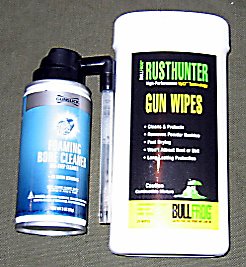
Lastly I would like to share two good cleaning products with you. Outers Foaming Bore Cleaner and BullFrog Rust Hunter Gun Wipes. The Foaming Bore Cleaner is the best product that I have found for removing lead, powder, and most importantly copper fouling from pistol barrels. The Gun Wipes are a very convenient product and do a great job of cleaning the grime off of the rest of my revolvers and semi-auto pistols. The Gun Wipes do state however that they should not be used on wood or plastic, so you Glock toting polymer princesses be warned, these wipes are only for men who pack real steel.
Saturday, July 15, 2006
Fun Six Guns and Fightin' Six Guns
· Beretta Laramie in .45 Colt
· Cimarron Arms Model 1872 Navy in .38 Special
· S&W Model 21 in .44 Special
· S&W Model 22 in .45 ACP
Fun Six Guns
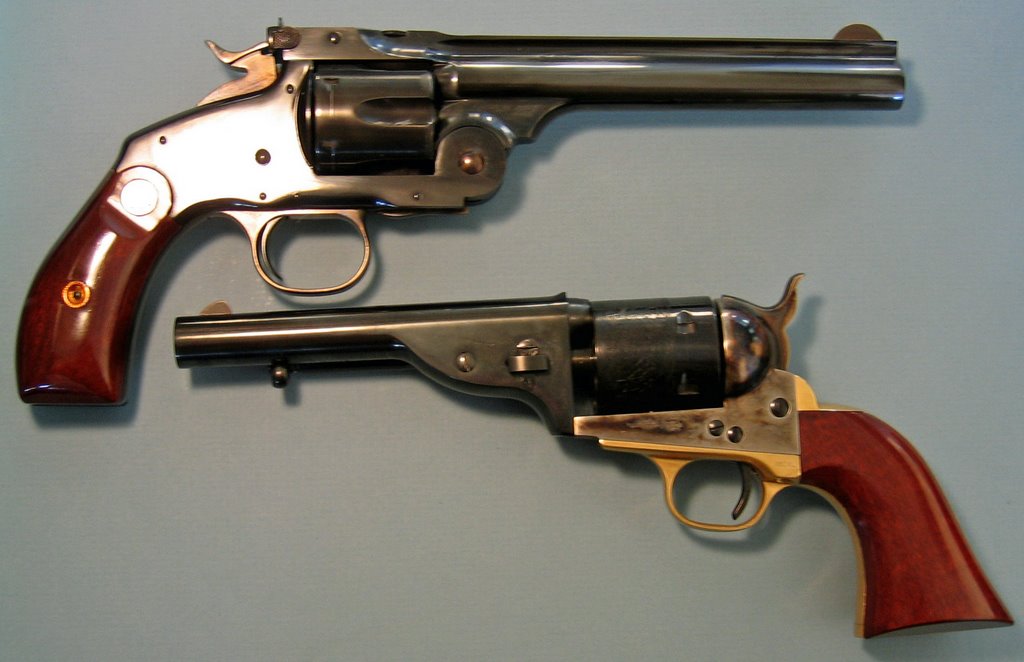
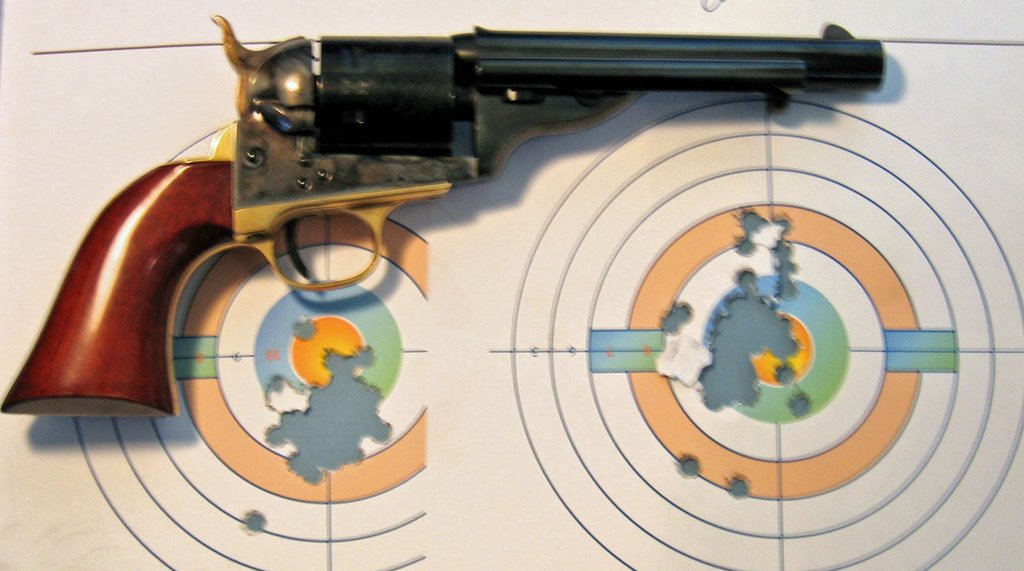
We will start by examining two fun-shootin’ six guns; the Beretta Laramie in .45 Colt and the Cimarron Arms Model 1872 Navy in .38 Special.

The Laramie (top) is Beretta’s offering of the Smith & Wesson Model 3 and the Model 1872 Navy is Cimarron Arms’ rendition of Colt’s first metallic cartridge revolver. Both of these revolvers share some subtle similarities; both are made by Uberti, of Italy, (and marketed respectively by Beretta and Cimarron Arms), both replicas are being produced in calibers for which they were not originally chambered (.45 Colt for the Laramie and .38 Special for the 1872 Navy), they were originally produced in about the same time period and were in competition for the same markets.
To understand the evolution of these two revolvers we have to go back to Smith & Wesson’s beginnings in the 1850’s. Horace Smith and Daniel Wesson created their first partnership in 1852 and manufactured the Volcanic repeating pistol. After a production of 1,000 pistols, they sold their company to Volcanic Repeating Arms Company in mid-1855. They then formed a second partnership a year later to develop a self-contained metallic-cartridge handgun whereupon they produced the S & W Model 1 First Issue Revolver. These revolvers were produced in caliber .22 short. During the Civil War many were privately purchased by Union officers. Despite the woefully impotent caliber, the officers were drawn to the Model 1 due to the ease of reloading. The Model 1 was a fairly small handgun by the standards of its day and had no trigger guard. It held seven metallic cartridges and was reloaded by unfastening the catch at the front of the cylinder frame and then swinging the barrel, which was hinged at the top, upward. You dumped the cartridges, used the rod attached underneath the barrel to bash out any cartridges stuck in the cylinder, reloaded and went back to battle. Certainly not as fast as pressing the magazine release on your semi-auto pistol and slamming home another 18 rounds of 9mm, but the Smith & Wesson #1 was much faster to reload than the percussion cap and ball blackpowder revolvers the military issued from Colt and Remington.

Smith & Wesson Model 1
It is fairly easy to imagine an officer charging (or being on the receiving end of a charge), expending the contents of his large caliber Colt or Remington and then reaching for the Smith & Wesson #1 to keep fighting. I would also imagine that, while the officer wielded his saber in his right hand, the S&W .22 short was easy to shoot with his left hand. In the War Between the States, the saber was still touted as the proper weapon for field officers and cavalry troops. Young Lieutenant George Armstrong Custer, fresh from West Point, openly questioned this in his first series of cavalry charges. He felt the left-handed, cross draw holster was poorly placed and also conjectured that the revolver was a much more effective weapon in a cavalry charge than a saber. Fifty years later, when the doughboys went to Europe, the horseback cavalry was present, but the saber had been permanently replaced by the Colt Model 1911 in .45 ACP.
After the Civil War Smith & Wesson increased the size of the revolver and produced them in larger calibers. The model #2 was produced in .32 caliber and then the Model #3 which was most popularly produced in some variation on the .44 caliber bullet. The #3 was hinged at the bottom of the barrel frame and opened by pushing upward on the rear sight which also served as the “catch” holding the revolver together. This function became to be known as a “break-top” revolver and when you “broke open” the revolver and swung the barrel down an extractor pushed the metallic cartridges out of the cylinder. This made the Smith & Wesson much easier and faster to reload. It was so well liked by the Tsar of Russia, that the Russian government purchased 130,000 model #3s for their troops. The ease of reloading and use of self-contained metallic cartridges would seemingly give Smith & Wesson a vast advantage over Colt, but for reasons unknown to me, Smith & Wesson did not become the dominant manufacturer of the era. Even so the Model 3 found its way into limited military service either through private purchase or limited government contracts. The model 3 also had its place in the taming of the Wild West. Among the noted individuals reported to carry one of the various S&W Model 3’s were Frank & Jesse James, Buffalo Bill Cody, Annie Oakley, John Wesley Hardin, Pat Garrett, Cole Younger, Bill Tilghman, Belle Starr, Theodore Roosevelt, and Virgil Earp.
During this period Colt realized that the revolver technology was changing and they needed to catch up. Colt was forced to wait until the S & W patent expired before they could offer their firearms in self-contained metallic cartridges. Once the patent expired, Colt and other manufacturers converted their “cap and ball” revolvers to fire cartridges. These were known to collectors as “Colt Conversions,” were produced in comparably small numbers, and hold a high collector’s value today.
The Colt Model1872 Open Top appears be a conversion, but it was actually Colt’s first revolver specifically manufactured to fire a self-contained cartridge, in .44 Henry Rimfire, and has a loading gate on the right side of the cylinder frame and a spring-loaded manual ejector rod offset to the right underside of the barrel just as would be found on the later and vastly popular Colt Model P (Peacemaker) revolver.
Shooting the Replicas (all targets were shot at 21 feet unless otherwise noted).
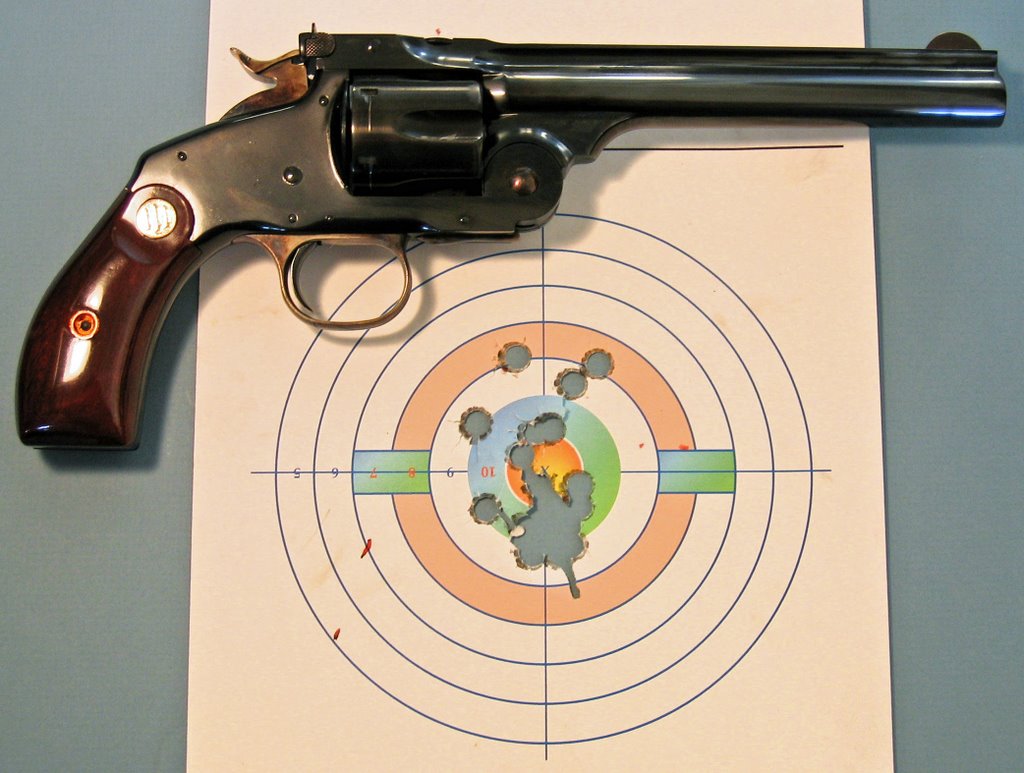
The Beretta Laramie is a beautiful revolver. The bluing is deep and rich and the grips almost have an orange hue which provides a nice contrast against the blue steel. Darker walnut grips would probably more correct for this reproduction but I do not mind. What I am not wild about from an aesthetic point are the gold Beretta medallions inset into the grips—this affectation is untrue to the original design. This is a minor complaint about appearance and certainly does not affect the functioning of the revolver. While the revolver shot high for me, the sights were well regulated for windage (in fact they are adjustable for windage via two small screws on the face of the rear sight) and it was not difficult to lower the front sight and hit the bulls eye pretty regularly.

Baretta Laramie .45 Colt fired at 21 feet
The Laramie is chambered for the .45 Colt Cartridge. In shooting the Black Hills .45 Colt Cowboy Loads the big 250 grain chunk of lead lumbers toward the muzzel at a slow 725 feet per second. It almost seemed like I could feel bullet spiraling down the barrel.
The Cimarron Model 1872 was a surprise. This is a another handsome gun with a nice deep blue, brass grip frame, roll engraved cylinder, and case-colored charcoal hardened cylinder frame, trigger and hammer. Other than the .38 special caliber, this revolver is true to the original in every detail.
While it did shoot a little low, the application of a little Kentucky elevation brought the groups to the orange dot on the targets. I was surprised at the accuracy of this revolver due to the rear sight which is a very, very small bump with a slit in it and is situated where the barrel meets the cylinder.

Cimarron 1872 .38 Special fired at 21 feet
The Fightin’ Sixguns
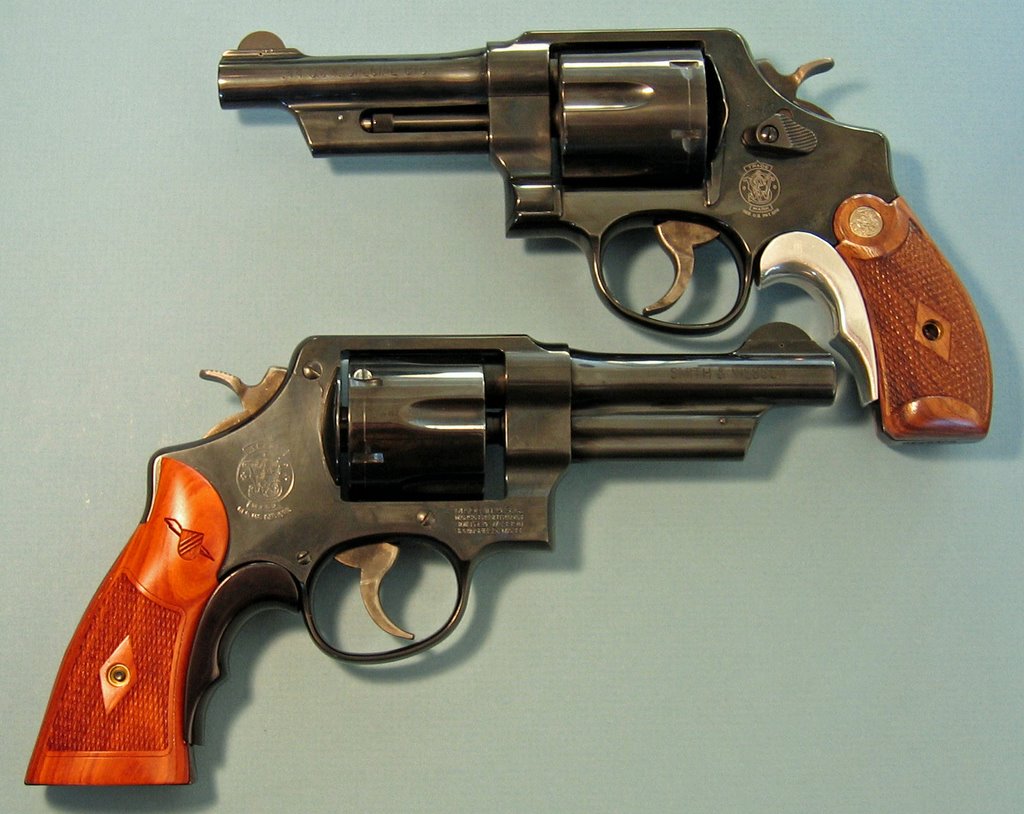
It is great to see Smith & Wesson producing these two serious sixguns again. I am speaking about the Model 21 in .44 Special and the Model 22 in .45 ACP. In an earlier range report I wrote about instructor Clint Smith’s petitioning of Smith & Wesson to re-introduce the Model 21 so I
will not cover that ground again. Based upon the popularity of the .44 Special Model 21, Smith & Wesson brought back the .45 ACP version as the Model 22.

Smith & Wesson Model 21 .44 Special (top)
Smith & Wesson Model 22 .45 ACP (bottom)
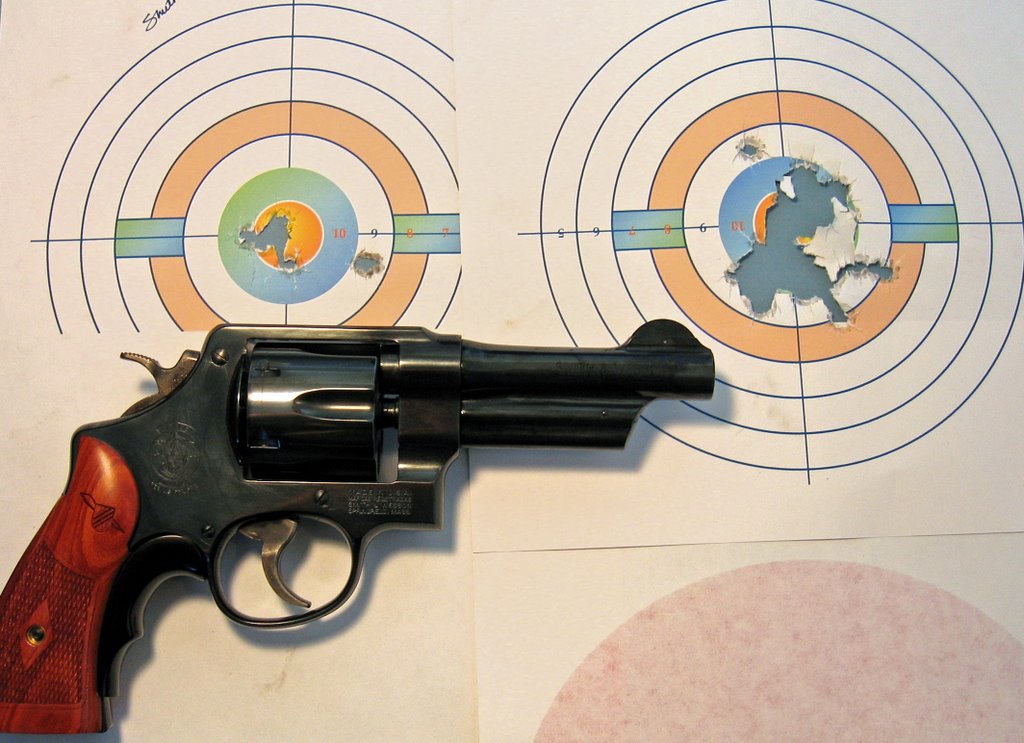
Other than caliber, the only differences between these two renditions are the grip frames and grips. The .44 Special came with a round butt and a set of chunky Ahrens grips which, while certainly functional, I immediately discarded and replaced with a set of reproduced vintage S&W diamond checkered service grips and added a Tyler T-grip adapter. These grips are very handsome, consistent with the period of the revolver’s production and also very functional. The .44 Special’s sights are well regulated for me and have given me excellent accuracy.

Model 21 .44 Special fired at 21 feet
After the .44 special was brought out, shooters suggested that the next revolver be manufactured with a square butt and proper vintage diamond checkered Magna grips. The grips have an orange hue to them and have the logo for Clint Smith’s Thunder Ranch Academy laser engraved on them. When I first saw them in a magazine I began looking for appropriate after market replacements. I am old enough to have owned original Smith & Wesson revolvers with the Magna grips and always thought they had terrible, blocky ergonomics (although in those days we didn’t know what ergonomics was, we just said the grips didn’t feel good). When I picked up this revolver I was surprised at how good these grips felt. Upon further examination I found that the grips had been rounded and contoured where the thumb and trigger finger make contact. These felt good and the only thing necessary to make them even more functional was a Tyler T grip adapter.
The .45 ACP shot a little low, but was easy to bring on to the target.

Model 22 .45 ACP fired at 21 feet
The single action trigger pulls on the 21 and 22 are absolutely great and the double action, while a little heavy, is quite a relief from the lawyer-proof 13 pound pulls that they have been putting on most of their handguns these days. Both of these revolvers hearken back to the day (when writing about going “back to the day” it is always best to use a word like “hearken”) when a desperado trying to run a police roadblock would be stopped in his tracks by a deputy who threw a chunk of .44 or .45 caliber lead through the lawbreaker’s windshield. I can only hope that the next evolution of this series is a revolver in .45 Colt.