

Showing posts with label Messages from Average Joe. Show all posts
Showing posts with label Messages from Average Joe. Show all posts
Sunday, August 16, 2009
Sunday, May 31, 2009
Thanks for Reading
I began this blog in 2006 and on May 31st of last year I got around to attaching a hit counter. I started this blog as a way to report weekend range sessions with a couple of friends in Arizona and thought that only a handful of people was actually reading this thing. Never in my wildest dreams would I think that in the span of a year this blog would receive 181,381 visits. According to Bravenet there are thousands of regular visitors with many new readers discovering the blog every week.
I only hope that you find the material interesting and useful. Thanks again for your visits.
Saturday, May 16, 2009
The Votes Are In!
Thanks to all who participated. The next reviews will be written in the following order:
1. Glock Model 36 .45 ACP
2. Kahr MK9 9mm
3. SIG P229 .357 SIG
4. CZ P07 9mm
5. H&K P30 9mm (The H&K and the CZ will make a nice comparison article as they are both polymer framed, DA/SA, carry sized 9mms)
6. SIG P226 Blackwater 9mm
7. SIG P220 Platinum Elite in .45 ACP
8. Glock Model 17L 9mm
9. SIG 229 Equinox in .40 S&W
10. Glock Model 38 in .45 GAP (this pistol deserves more respect)
11. SIG P226 Elite in 9mm
12. SIG P229 Platinum Elite in 9mm
Tuesday, May 05, 2009
Sunday, April 26, 2009
The Results Are In
The poll has closed regarding the topic "Should I Continue This Blog".
295 people or 95% said "Yes".
8 people or 2% said "Who Cares".
1% or 5 people said "No" and I would like to thank President Obama, Vice-President Biden, Attorney General Eric Holder, Speaker of the House Nancy Pelosi, and Senator Diane Feinstein for breaking away from their pursuit of socialism to partake in my survey.
The poll has closed regarding the topic "Should I Continue This Blog".
295 people or 95% said "Yes".
8 people or 2% said "Who Cares".
1% or 5 people said "No" and I would like to thank President Obama, Vice-President Biden, Attorney General Eric Holder, Speaker of the House Nancy Pelosi, and Senator Diane Feinstein for breaking away from their pursuit of socialism to partake in my survey.
Saturday, July 12, 2008
AVERAGE JOE IS NOW ON THE AIR


Average Joe has joined The Shot Show Podcast as a contributor of handgun reviews. Doc Wesson, who produces the show, has invited me to be a part of his broadcasts every other episode to provide my perspective on the handguns that I have reviewed.
Please stop by, download, and take a listen to the program that Doc puts together. Doc reports on gun related news and offers his commentary, along with with interviewing different guests of interest. This is a very professional produced Podcast and I am honored to contribute to it.
The Podcast can be found at: http://theshotshow.us.tf/
Sunday, July 06, 2008


.JPG)

Sunday, April 13, 2008
Coming Attractions!

Ghost Ring Speed Night Sights on the Model 23

Smith & Wesson Model 952 9mm


SIG-Sauer P6 with Heinie Straight 8 Night Sights and Wood Grips of Unknown Origin


I haven't had much time to write, so here are some photos of upcoming reviews:
Left: Glock Model 19C 9mm with Advantage Tactical Sights Glock Model 23 .40 S&W with Ghost Ring Speed Sights.
Advantage Tactical Sights on the Model 19C with the Compensated Barrel/Slide.

Ghost Ring Speed Night Sights on the Model 23

Model 36 .45 ACP with Federal Arms Ported Barrel and Hi-Viz Night Sights


Browning 9mm Hi-Power with Hogue Walnut Grips


Smith & Wesson Model 952 9mm

CZ Model 97 .45 ACP

Walther THP .22LR

SIG-Sauer P6 with Heinie Straight 8 Night Sights and Wood Grips of Unknown Origin

Smith & Wesson Model 640 .357 Magnum

Tuesday, October 09, 2007
Update on Sig P220 Elite Carry
Suzy, as I have affectionately named my P220 EC, was sent back to the factory to correct the failure to feed problems outlined in the last paragraph of the previous posting. I took her to the UPS Customer Center on a Friday afternoon and she was returned to me on the following Thursday--that's pretty fast customer service. They replaced the extractor and polished the feed ramp. Reliability is now 100% and still as accurate as ever.
Suzy, as I have affectionately named my P220 EC, was sent back to the factory to correct the failure to feed problems outlined in the last paragraph of the previous posting. I took her to the UPS Customer Center on a Friday afternoon and she was returned to me on the following Thursday--that's pretty fast customer service. They replaced the extractor and polished the feed ramp. Reliability is now 100% and still as accurate as ever.
Sunday, April 22, 2007


Sunday, October 08, 2006
Advanced Laser Weaponry
The advent of a War always brings about new technology. Afterall, war is a very violent form of competition and out of competition comes ingenuity, innovation, and achievement. It is no surprise then that the "bar has been raised" for "State of the Art" close quarter combat technologies in the last 16 years. Two Gulf Wars have seen the enhancement of missle and bombing delivery systems but little news has trickled out about advancements in hand-held anti-personnel arms. Last week I was priviledged to attend a hush-hush training session in Southern California which gave me a strong glimpse at what the wizards of weaponry have been working on.
Advanced Laser Technology:
Because of it's precise properties Laser Beam technology has been used in everything from presentation pointers, to carpenter's levels, to advanced sighting systems for handguns, rifles, and missle systems. The thought of the Laser as a weapon has been a sci-fi staple since Flash Gordon was first issued his "Ray Gun" all the way to the light sabers used in "Star Wars". However, the fantasy is now a devastating reality.

It would be appropriate at this point to discuss what I liked and disliked about this weapon. The Blaster's exterior components are made of polymer, which I normally do not like, however the polymer construction has certainly made this a light-weight weapon. Unfortunately the Blaster is rather bulky so the light-weight does not translate into making this a good weapon for concealled carry. This is definately a service pistol and quite frankly, that is what is was designed to be. The lack of recoil makes follow-up shots very easy and the fixed sights seemed to be fairly well regulated. Unfortunately the puny sights were difficult to immediately read and this made accurate first shots very difficult. Most of the people involved in the training session opted to used a modified point-shooting style, see where the first shot (or blast) hit and then compensate on their follow-up shot for windage and elevation. Due to the red laser beam it is easy to see where the first shot landed and, as a plus, the white circle at the rear of the Blaster indicates when it senses that you have scored a direct hit by flashing a short red strobe. While there is a lot to like about the Blaster I must point out that the trigger is horrible. It is very spongy and therefore may cause the shooter to jerk the trigger finger causing the muzzle to be pulled down and to the right. This is probably a factor caused by the fact that this weapon is so new that the makers were not sure how to contruct the trigger or firing mechanism. After, the trigger on the Blaster is not cocking and dropping a hammer or otherwise propelling a firing pin forward. When pressed the trigger actually completes an electrical circuit which generates the laser blast.
Overall the Blaster has great potential, but could stand further refinement in terms of sighting and the trigger. As I said earlier, my daughter had no problems with it...although I smoked her in competition.
The advent of a War always brings about new technology. Afterall, war is a very violent form of competition and out of competition comes ingenuity, innovation, and achievement. It is no surprise then that the "bar has been raised" for "State of the Art" close quarter combat technologies in the last 16 years. Two Gulf Wars have seen the enhancement of missle and bombing delivery systems but little news has trickled out about advancements in hand-held anti-personnel arms. Last week I was priviledged to attend a hush-hush training session in Southern California which gave me a strong glimpse at what the wizards of weaponry have been working on.
Advanced Laser Technology:
Because of it's precise properties Laser Beam technology has been used in everything from presentation pointers, to carpenter's levels, to advanced sighting systems for handguns, rifles, and missle systems. The thought of the Laser as a weapon has been a sci-fi staple since Flash Gordon was first issued his "Ray Gun" all the way to the light sabers used in "Star Wars". However, the fantasy is now a devastating reality.
Our instruction on the new weapons system was very basic and, quite frankly, there was not much need to over complicate matters. The military has long been looking for ways to simplify small arms training and, as seen in the Manual of Arms below, this has been achieved with astounding success:






It would be appropriate at this point to discuss what I liked and disliked about this weapon. The Blaster's exterior components are made of polymer, which I normally do not like, however the polymer construction has certainly made this a light-weight weapon.
 Unfortunately the Blaster is rather bulky so the light-weight does not translate into making this a good weapon for concealled carry. This is definately a service pistol and quite frankly, that is what is was designed to be. The lack of recoil makes follow-up shots very easy and the fixed sights seemed to be fairly well regulated. Unfortunately the puny sights were difficult to immediately read and this made accurate first shots very difficult. Most of the people involved in the training session opted to used a modified point-shooting style, see where the first shot (or blast) hit and then compensate on their follow-up shot for windage and elevation. Due to the red laser beam it is easy to see where the first shot landed and, as a plus, the white circle at the rear of the Blaster indicates when it senses that you have scored a direct hit by flashing a short red strobe. While there is a lot to like about the Blaster I must point out that the trigger is horrible. It is very spongy and therefore may cause the shooter to jerk the trigger finger causing the muzzle to be pulled down and to the right. This is probably a factor caused by the fact that this weapon is so new that the makers were not sure how to contruct the trigger or firing mechanism. After, the trigger on the Blaster is not cocking and dropping a hammer or otherwise propelling a firing pin forward. When pressed the trigger actually completes an electrical circuit which generates the laser blast.
Overall the Blaster has great potential, but could stand further refinement in terms of sighting and the trigger. As I said earlier, my daughter had no problems with it...although I smoked her in competition.

Sunday, September 24, 2006
Stay Tuned...Vanity Project In-Progress
I have always wanted to have a pistol, customized to my specifications, however most custom pistols and revolvers begin at close to $3 grand and go up. But now I have seized the opportunity to do one that I will really like, for a fraction of the price. How you ask? Well the pistol that I am starting with was handfit at the Colt factory before Colt discontinued making them in 1945. Therefore extensive hand-tuning doesn't need to be done. Well then, a discontinued Colt, especially one that was handfit at the factory would be rather costly, right? Well yes. In fairly good condition they run about $500. Add to the fact that the caliber I was looking for was only produced in small numbers and that would push it to around $700. In great condition a they run close to a grand and special engraving or military marked models will propel the price close to the $3 grand mark again. But this one was very cheap because it was in pretty lousy shape. Have you figured out what I am talking about? It is a Colt Pocket Hammerless in .380 ACP. This one is in bare bones condition, which is just what you would want if you are going to customize. I already own 2 of them; one in .32 ACP, the Model 1903, and one in .380 ACP, the Model 1908. However, they are in such good condition that they have too much collector value to mess with them. The one I just purchased doesn't have much collector value...yet.
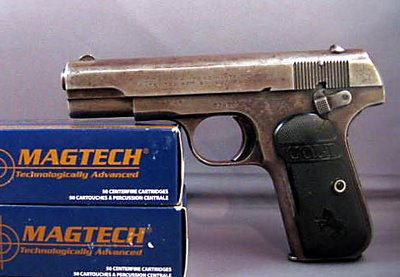 As you can see, this one doesn't have a patch of original bluing left on it and has developed gray-brown patina. The left grip panel has a huge chip out of it and a long, wide crack. The slide safety is so loose that the wind could blow it 180 degrees if the grip wasn't there.
So, some of the modifications are pretty obvious. 1. The pistol needs to be reblued. 2. The slide safety needs to be replaced. 3. The grips need to be replaced (and while new replacement grips have been manufactured from the originaly Colt castings, the gunsmith that will be doing the work has a set of vintage J. Scott Mother-of-Pearl grips that will set this piece off beautifully). 4. The recoil spring needs to be replaced (since the serial number puts this pistol as having a manufacturing date of 1922, it's probably time to change the spring). The real customization of this piece will be new sights. As was the fashion at the time, these pistols were made with what can only be politely described as "nominal" sights. This is one of the most perfect pistols ever produced, the only things wrong are the minimal sights and the fact that the magazine release is on the heal of the grip instead the 1911 type button release just behind the trigger on the left grip frame. The gunsmith showed me a set of low profile 1911 3-dot sights that will do nicely. As for the magazine release...I'll live with it where it is. To have it removed and a 1911 style rebuilt into the grip frame would cost too much and I have only seen one Colt Pocket Hammerless (in a magazine) with that modification. The last piece that we were looking at replacing is the barrel. While the rifling in this barrel is very good, there is some erosion and what appears to be a slight ring about a third of the way up from the chamber. Not to worry, plenty of replacement barrels are out there.
I then shot the pistol so see if it functioned OK. The pistol functioned flawlessly. I put 100 rounds through it with no problems.

And...the accuracy is top notch as shown in these targets which were set at 21 feet. 25 rounds were fired at each target. The accuracy is so good that the original barrel is staying; erosion, barrel ring and all. If it ain't broke, don't fix it. These targets are not bad for an 84 year old pistol in poor shape with almost non-existant sights! This is a true testiment to the genius of John M. Browning's design and the manufacturing standards that Colt used to have.
So stay tuned! These are the "before" shots and I can't wait to show you the "after" photos.
I have always wanted to have a pistol, customized to my specifications, however most custom pistols and revolvers begin at close to $3 grand and go up. But now I have seized the opportunity to do one that I will really like, for a fraction of the price. How you ask? Well the pistol that I am starting with was handfit at the Colt factory before Colt discontinued making them in 1945. Therefore extensive hand-tuning doesn't need to be done. Well then, a discontinued Colt, especially one that was handfit at the factory would be rather costly, right? Well yes. In fairly good condition they run about $500. Add to the fact that the caliber I was looking for was only produced in small numbers and that would push it to around $700. In great condition a they run close to a grand and special engraving or military marked models will propel the price close to the $3 grand mark again. But this one was very cheap because it was in pretty lousy shape. Have you figured out what I am talking about? It is a Colt Pocket Hammerless in .380 ACP. This one is in bare bones condition, which is just what you would want if you are going to customize. I already own 2 of them; one in .32 ACP, the Model 1903, and one in .380 ACP, the Model 1908. However, they are in such good condition that they have too much collector value to mess with them. The one I just purchased doesn't have much collector value...yet.
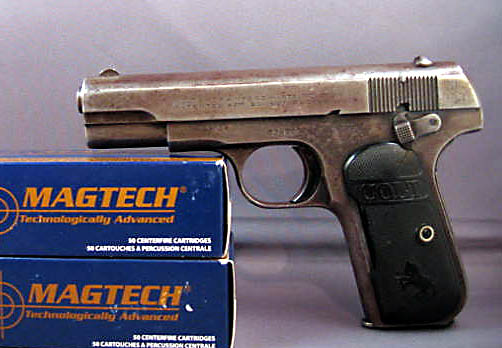 As you can see, this one doesn't have a patch of original bluing left on it and has developed gray-brown patina. The left grip panel has a huge chip out of it and a long, wide crack. The slide safety is so loose that the wind could blow it 180 degrees if the grip wasn't there.
So, some of the modifications are pretty obvious. 1. The pistol needs to be reblued. 2. The slide safety needs to be replaced. 3. The grips need to be replaced (and while new replacement grips have been manufactured from the originaly Colt castings, the gunsmith that will be doing the work has a set of vintage J. Scott Mother-of-Pearl grips that will set this piece off beautifully). 4. The recoil spring needs to be replaced (since the serial number puts this pistol as having a manufacturing date of 1922, it's probably time to change the spring). The real customization of this piece will be new sights. As was the fashion at the time, these pistols were made with what can only be politely described as "nominal" sights. This is one of the most perfect pistols ever produced, the only things wrong are the minimal sights and the fact that the magazine release is on the heal of the grip instead the 1911 type button release just behind the trigger on the left grip frame. The gunsmith showed me a set of low profile 1911 3-dot sights that will do nicely. As for the magazine release...I'll live with it where it is. To have it removed and a 1911 style rebuilt into the grip frame would cost too much and I have only seen one Colt Pocket Hammerless (in a magazine) with that modification. The last piece that we were looking at replacing is the barrel. While the rifling in this barrel is very good, there is some erosion and what appears to be a slight ring about a third of the way up from the chamber. Not to worry, plenty of replacement barrels are out there.
I then shot the pistol so see if it functioned OK. The pistol functioned flawlessly. I put 100 rounds through it with no problems.

And...the accuracy is top notch as shown in these targets which were set at 21 feet. 25 rounds were fired at each target. The accuracy is so good that the original barrel is staying; erosion, barrel ring and all. If it ain't broke, don't fix it. These targets are not bad for an 84 year old pistol in poor shape with almost non-existant sights! This is a true testiment to the genius of John M. Browning's design and the manufacturing standards that Colt used to have.
So stay tuned! These are the "before" shots and I can't wait to show you the "after" photos.
Subscribe to:
Posts (Atom)