What I Am Keeping and Carrying
The most frequent question I am asked is if I am independently wealthy to have so many handguns. The answer is an emphatic "No"! Some of the pistols reviewed were rented, some were loaned, many were bought used at a great price, and some were purchased new. I am always wheeling and dealing to get something new or unusual so I can come up with an interesting review. However, over the last six years I did find that the safe was beginning to bulge at the seams and I realized that I had a plethora of pistols that never saw daylight. I mulled over the prospect of selling some of them. A few were easy to part with, but most were not. Slowly I began to put them on consignment and actually got caught up in a selling frenzy after the current commander-in-chief was elected because they sold fast and at very good prices. A few actually sold for more than I paid for them.
Finally I realized that if I clarified the mission for which I needed a handgun it would be easier to determine what to sell and what to keep. Well I don't hunt so away went the large "N" framed revolvers in .44 Special, .45 ACP, .45 Colt, .357 Magnum, .41 Magnum, and .44 Magnum.
I don't participate in shooting competitions so the large framed, long barreled semi-automatic pistols in .9mm, .40 S&W, .45 ACP, and 10mm left me too. These were a little harder to get rid of since most of them were superbly accurate.
The mission for my handguns was simple: they are for self-defensive concealed carry. So I am keeping what I carry. Now, within this mission there are also sub-missions that needed to be categorized and considered and those were:
- What to keep for all-around general purpose carry.
- What to keep for those times that only the smallest can be carried.
- What to keep for when the feces hits the fan.
Out of the approximately 60 handguns in my safe I am down to these six:- For all-around general purpose carry; the STI Rogue in 9mm and the Glock Model 36 in .45 ACP.
- For those times when only the smallest can be carried I chose two .380 ACP pistols; a vintage Walther PPK and a new SIG P238.
- For those times of feces hitting the fan I selected two more Glocks; the model 19 in 9mm and the model 38 in .45 GAP.
So, let's get to the specifics on why each of these were chosen. Two of these pistols haven't bee fully reviewed yet and I am not going to go into a full review here; so on the SIG P238 and Glock Model 38 I am just going to relate the basics of why it was chosen without an in-depth examination of the pistol.
Walther PPK .380 ACP

Although I don't really like to leave the house with a mouse gun there are times when something larger just isn't practical and a .380 is better than nothing. I try to rationalize this by remembering that most of Europe's police departments (and some of their Army's) issued .32 ACP pistols from the turn of the last century through the mid-1970's. Even General George S. Patton kept one or two of them with him during his WWII Campaign (I think they were a Colt and Remington both in .380 ACP).
I kept the Walther PPK because of size and accuracy. It is very concealable in an inside the waistband holster and can be carried in a pocket in a pinch. I find it a little large and heavy for pocket carry but if your pants are made of a sturdy material and the pockets are the right size it is possible. This little pistol was imported just a few years before the Gun Control Act of 1968 banned them from importation in the original PPK size. This baby is accurate beyond what a pistol of this size should be and accuracy is of key importance when carrying a cartridge of lesser power. The target below was fired at from two distances: the head shots were made at 21 feet and the torso shots at 50 feet.
Walther PPK At-A-Glance:.380 ACP | .38 Special/9mm | .45ACP/GAP | .357 Mag/SIG | .44 Mag |
Ease of Carry/Concealment
Too Large to Conceal | Service Sized | Compact | Ultra Compact | Micro Compact | Pocket Pistol |
Accuracy Rating
Can’t Hit the Broad Side of a Barn | Acceptable | Combat | Bullseye |
SIG P238 .380 ACP (Not Yet Reviewed)

The Sig P238 is a new venture for SIG producing a .380 sized single action pistol that looks like a diminutive 1911. Colt made this version over 20 years ago as the Mustang. This reproduction is better made and has much better sights than the Colt product (nights sights at that). I kept it because it is smaller and lighter than the Walther PPK. It is as small as I am willing to go; there are other smaller .380's on the market from Keltec, Ruger, Kahr, and Taurus (although I have not come across the later two pistols). While it is smaller than the Walther it is not as accurate. I have not completed my testing of this pistol and have not yet determined the boundary of it's practical range.
SIG P238 .380 ACP At-A-Glance
Power Scale
.380 ACP | .38 Special/9mm | .45ACP/GAP | .357 Mag/SIG | .44 Mag |
Ease of Carry/Concealment
Too Large to Conceal | Service Sized | Compact | Ultra Compact | Micro Compact | Pocket Pistol |
Accuracy Rating
Can’t Hit the Broad Side of a Barn | Acceptable | Combat | Bullseye |
STI Rogue 9mm

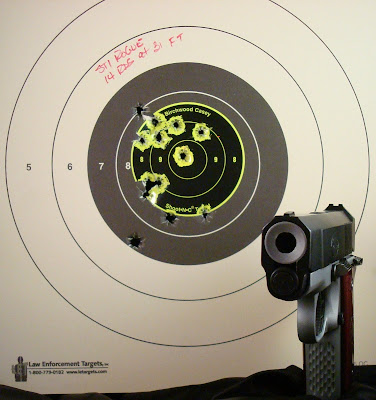
I reviewed this pistol just a little while ago. This marvelous small pistol rides all day in an inside the waistband holster so well you will forget that it is there. She holds 8 rounds of 9mm and I carry a spare 9 round magazine in my pants pocket so I have 17 rounds at my disposal in a very small package. While she does not have night sights, the sights are easily visible, recoil is not a problem and she is near bullseye competition accurate at close and moderate ranges. I have no problem keeping all rounds on a silhouette target at 75 feet. The 9mm is also a very versatile cartridge. You can get them loaded light and you can get them loaded hot with ballistics that approach the .357 magnum level. I keep this baby stoked with Speer Short Barreled 124 grain + P Gold Dot Hollowpoint ammunition.
The targets below are as follows:
- 14 rounds fired at 21 feet
- 14 rounds fired at 31 feet
- Head shots at 21 feet and Torso shots at 50 feet
- 75 feet



STI Rogue 9mm At-A-Glance
Power Scale
.380 ACP | .38 Special/9mm | .45ACP/GAP | .357 Mag/SIG | .44 Mag |
Ease of Carry/Concealment
Too Large to Conceal | Service Sized | Compact | Ultra Compact | Micro Compact | Pocket Pistol |
Accuracy Rating
Can’t Hit the Broad Side of a Barn | Acceptable | Combat | Bullseye |
Glock Model 19 9mm

The Glock Model 19 is one of my "if the feces hits the fan" pistols and the reason is size, capacity, and accuracy. However one might say that there are several other pistols of the same size, identical or larger capacity, and same or better accuracy. Yes, but they are not Glocks and Glocks will have an advantage if the going gets rough. The advantage is availability of parts. Glocks are undoubtedly the most popular pistols in the world right now and they are also fairly easy to maintain and replace parts. Most gun shops around me carry just about any of the internals necessary if your Glock breaks down. Save for frames, slides, and barrels they carry magazines, springs, connectors, pins, magazine release buttons, slide release levers, etc.
The model 19 also gives you 15 + 1 rounds of the versatile 9mm and combat competition winning accuracy out of the box and gives it to you in a compact package that is easier to conceal than you might think.
The target below was hit with 15 rounds at 21 feet. The following target was fired at 50 feet with 35 rounds of ammunition.


Glock Model 19 9mm at-a-glance
Power Scale
.380 ACP | .38 Special/9mm | .45ACP/GAP | .357 Mag/SIG | .44 Mag |
Ease of Carry/ConcealmentToo Large to Conceal | Service Sized | Compact | Ultra Compact | Micro Compact | Pocket Pistol |
Accuracy Rating
Can’t Hit the Broad Side of a Barn | Acceptable | Combat | Bullseye |
Glock Model 36 .45 ACP

The Glock Model 36 is a brutish quasi-bullseye pistol masquerading as an ultra compact combat handgun. This pistol looks and means all business. It is small enough to ride all day in an inside the waistband holster if your cover shirt is heavy enough to disguise the print. The Model 36 is wider than the STI Rogue so it is just a little more difficult to conceal, but it packs a .45 caliber wallop. I carry it with the Pearce plus none magazine grip extender on it with the Pearce Plus one magazine grip extender on my spare magazine. This gives me 14 rounds of .45 ACP power if needed.
The Glock model 36 also supplies the accuracy of a service sized pistol as shown by the targets below:
- 9 rounds fired at 21 feet.
- 5 rounds fired at 31 feet.
- 10 rounds fired at 50 feet.
- 10 rounds fired at 75 feet.


Glock Model 36 .45 ACP At-At-Glance
Power Scale
.380 ACP | .38 Special/9mm | .45ACP/GAP | .357 Mag/SIG | .44 Mag |
Ease of Carry/Concealment
Too Large to Conceal | Service Sized | Compact | Ultra Compact | Micro Compact | Pocket Pistol |
Accuracy Rating
Can’t Hit the Broad Side of a Barn | Acceptable | Combat | Bullseye |
Glock Model 38 .45 GAP (not yet reviewed)

The model 38 is my final "feces hits the fan" pistol. It is on the compact frame and is thinner to hold than Glock's other double stack .45 ACP pistols. This is due to Glock working with ammo manufacturers to reduce the length of the .45 ACP round so that people with smaller hands can easily handle a .45 pistol. Glock's catalogue and website will tell you that is has the same dimensions as the model 19 9mm, but don't believe it. The model 38 is just a few centimeters wider than it's 9mm cousin. Not enough that it is extremely noticeable in the hand, but it is very noticeable when you try to stuff it into a holster built for the model 19.
I have not reviewed the model 38 yet so there will be no targets shown, but trust me; you could win a bullseye competition with this beauty and she holds 8 + 1 rounds of those big .45 caliber rounds.
Glock Model 38 .45 GAP at-a-glance
Power Scale
.380 ACP | .38 Special/9mm | .45ACP/GAP | .357 Mag/SIG | .44 Mag |
Ease of Carry/Concealment
Too Large to Conceal | Service Sized | Compact | Ultra Compact | Micro Compact | Pocket Pistol |
Accuracy Rating
Can’t Hit the Broad Side of a Barn | Acceptable | Combat | Bullseye |
So there you have the pistols that I am holding onto. Now, you may look at them and say, "Hey, Joe where are the revolvers". This was a difficult decision because I have a real soft spot in my heart for the Smith & Wesson model 340 PD in .357 magnum. But it came down to size and capacity. The STI Rogue is the same length but flatter, thinner, and holds 8 rounds compared to 5. The S&W sold quickly on consignment and for a better than fair price...but I do miss her.


