Wednesday, July 19, 2006

Colt Police Positive and S & W Heritage .44 Special


(click to enlarge picture)
Colt Police Positive in .32 Colt with "Angel Wing" Folding Knife by Gene Osborn.

This is a Colt Police Positive .32 Colt Target Model, nickle plated, in 95 to 98% original condition with a six inch barrel, windage adjustable rear sight, elevation adjustable front sight, and original Colt mother of pearl grips. The backstrap, trigger and hammer are all neatly checkered. The folding knife was crafted by artisan Gene Osborn of Center Cross Cutlery (www.centercross.com) and features an ATS-34 Hollow ground stainless steel blade on an extended tang lockback folder with mother of pearl handles, red expansion spacers and bronze damascus bolsters. The folder is fully fileworked and the titanium liners are multi colored.

Shooting the Police Positive
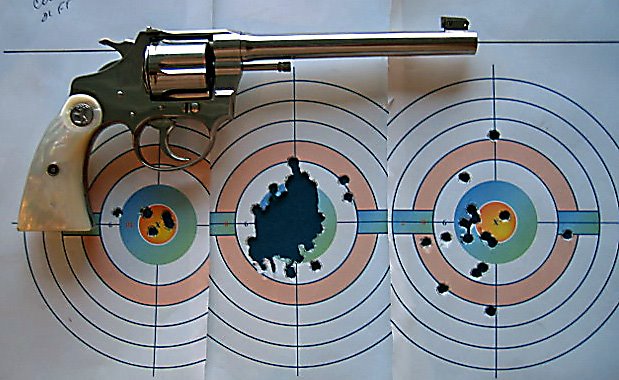
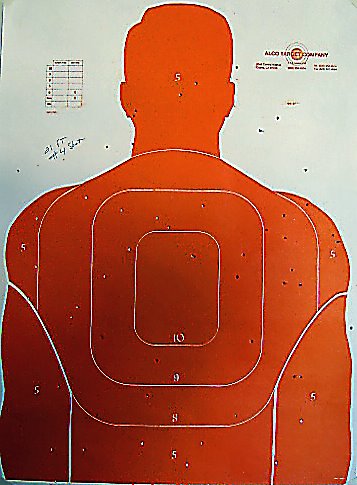
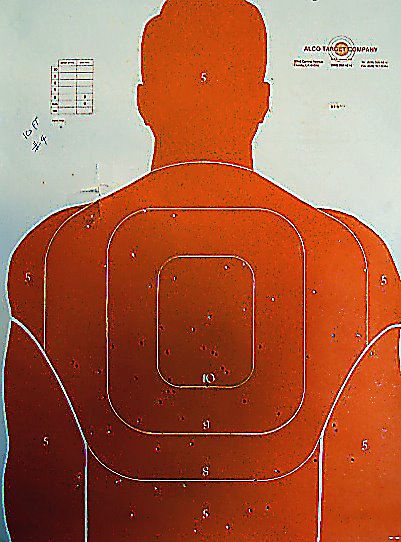
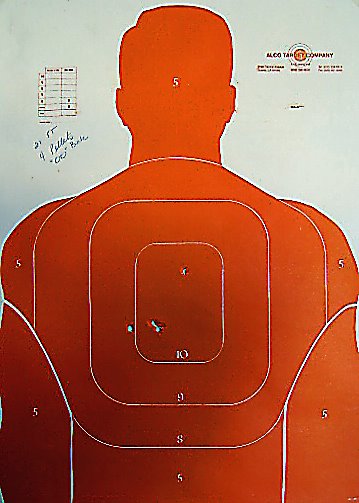
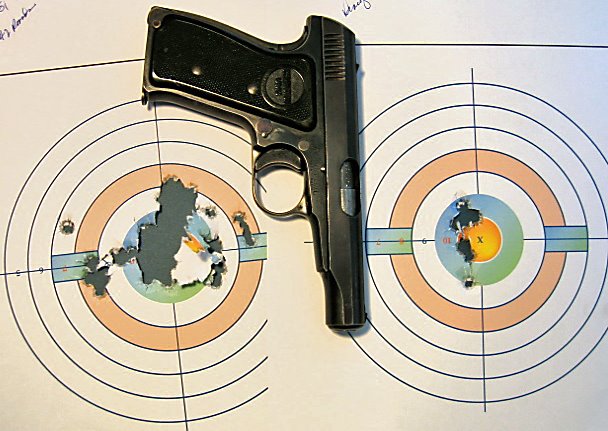
Left to Right: Six rounds was fired at the first target which was set at 21 feet. The second target was also set at 21 feet and absorbed 44 rounds. The last target was set at 40 feet and fired at with 16 rounds.


(Click photo to enlarge)

This Colt Police Positive is really a beautiful revolver and the Mother of Pearl grips are magnificent with streaks of red and blue visible when they catch the light. There is not a scratch, ding or piece flaking off. There is actually a swell in the center of the grips which had to have been difficult to execute by whoever fashioned these grips at Colt. Mother of Pearl just isn't that stable of a material and flakes, chips, and splinters quite easily. The grips were filling enough that I was not tempted to add a Tyler T-grip adapter to them as I have on most of my vintage revolvers. This revolver also had a beautiful trigger pull and begged to be fired double action. The DA pull was easy to stage (credit to Mike D. for teaching me that) and actually gave better accuracy in Double Action shooting than when firing Single Action. All shooting was done with Mag Tech 98 grain semi-jacketed hollow point ammunition. If Colt would go back to making revolvers with the same attention to detail and overall quality they would be in great demand.

Smith & Wesson Heritage in .44 Special

(click to enlarge picture)

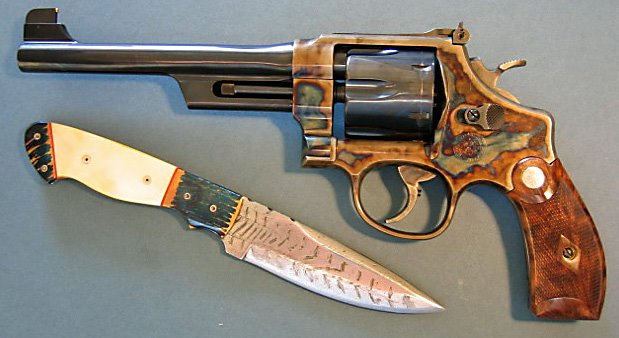
Smith & Wesson Heritage Revolver in .44 Special and "Devine Spirit" hunting knife by Gene Osborn.

The Smith & Wesson Heritage Series revolvers were made in the late 1990's and although some were exact copies of vintage S&W revolvers, this one is more of a blending of some of their older handguns. The .44 Special features a case colored frame with a blued barrel. The rear sight is adjustable for windage and elevation and the front sight is of the target variety with a gold bead. The gold bead picks up whatever light is available and this was the best sighting arrangement "back in the day' before fiber optic, glow-in-the dark, red dots and laser sighting systems. When I first saw the Smith & Wesson Heritage series advertised I wanted one, but never saw one in a gun shop. When the series was discontinued I gave up looking for one. As luck would have it, I just happened to be at a local gun shop right after someone brought a seemingly unfired specimen in to trade. It had not even been tagged for sale when I slammed down a layaway payment. The "Devine Spirit" hunting knife is another Gene Osborn creation and has gold-lip mother of pearl handles with red expansion spacers, Gene's own bronze cable Damacus bolsters (both front and rear), and a three billet composite cable damascus blade with opposite twists forged by Gene himself. The blade also has a false edge on top and filework on spine The Damascus is certainly unlike any I have ever seen, it almost looks antique. You will be hard pressed to find this Damascus steel in any other knife. The moniker "Devine Spirit" is the name I gave to this knife, not Gene. I call it "Devine Spirit" as a Japanese reference to the workmanship Gene has demonstrated in this knife. You see, the Japanese believe that a master bladesmith can put his spirit into the blade. They speak of the concept of a "live" blade. To many westerners who do not understand, they think that "live" merely means sharp. While it is sharp, "live", to the Japanese, it also infers that the spirit in the blade makes the blade alive and when the owner felt this he was bound by tradition to only use the blade in accordance with their code of honor.

Shooting the Heritage
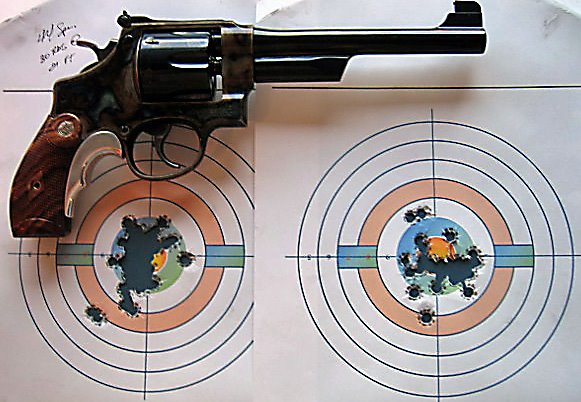
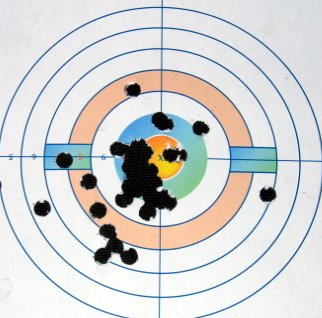
Two targets fired at 21 feet using Mag Tech 240 grain cartridges.

(click photo to enlarge picture)

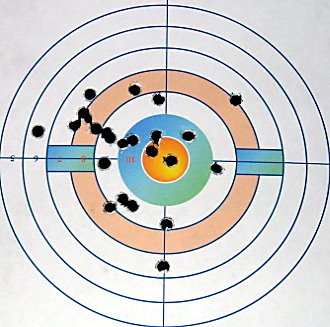
Target on the left was fired at 40 feet, target on the right was set at 50 feet. Both targets where shot with CCI Blazer 246 grain Gold Dot Hollow Point ammunition.

(click on photo to enlarge image)

The Smith & Wesson Heritage model is another great shooter. The area between the front strap and the trigger guard was a little too wide so I added a Tyler T-grips adapter to assist the handling of this great looking revolver. The Single Action Trigger pull was extremely light. Having an accidental discharge would be quite easy and really brought home the importance of always keeping the barrel pointed downrange and keeping your finger off of the trigger until ready to fire. The good new was that the double action pull was very good and not a hinderance to accurate shooting. Another good lesson is to always check your ammunition closely. The night before this range session I stopped and picked up two boxes of .44 Special; a box of Mag Tech and a Box of Winchester 240 grain target loads. At the range when I got to the Winchester ammo I placed them into the cylinder and it would not shut. I realized that just a little bit of the cartride was not going into the cylinder chambers. Upon closer inspection the ammunition was .44 Magnum, rather than .44 Special. Checking the box again it was clearly marked .44 Special. I am very thankful that I did not try to force the cylinder closed while it contained the magnum ammunition. Smith & Wesson no longer makes the Heritage series of revolvers and I feel very fortunate to have found one.

Sunday, July 16, 2006

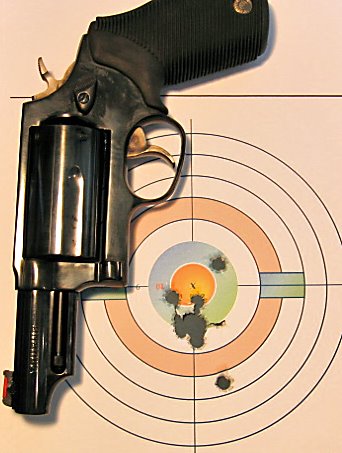
Ultimate Home Defense Revolver-Taurus .410/.45 Colt

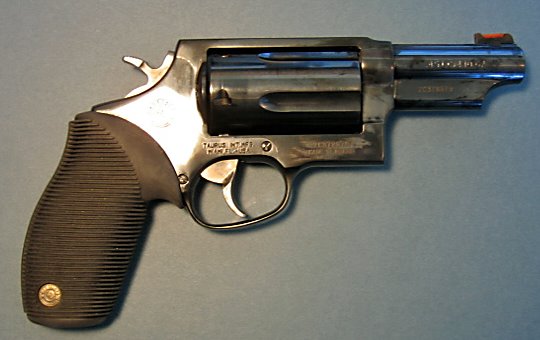
This is a weird looking revolver and while Taurus classifies it as a hunting arm, it seems to me that it would also make one darn good home defense handgun. While this revolver is pretty strange looking it also looks like it means business. She sports a 2.5 inch barrel with fixed sights at the rear and fiber optic red at the front.


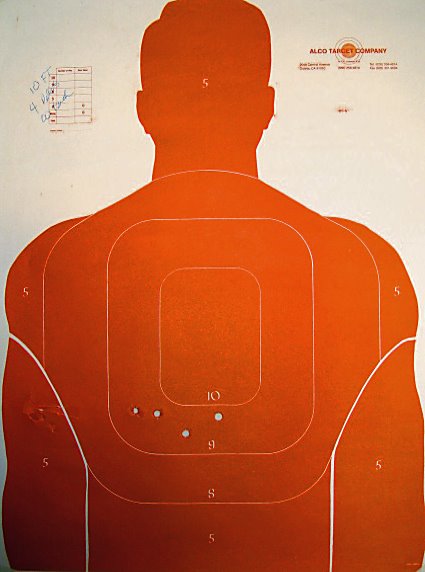
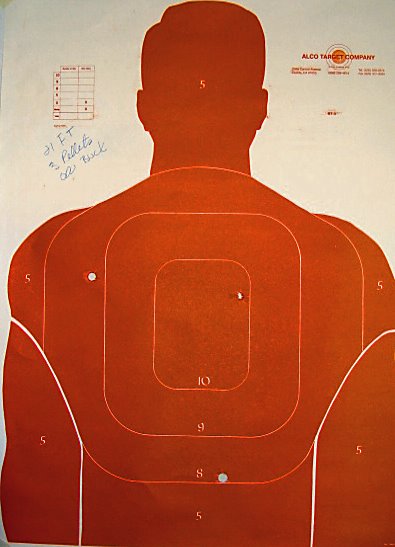
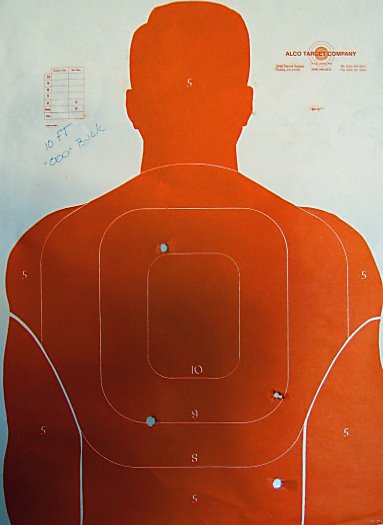
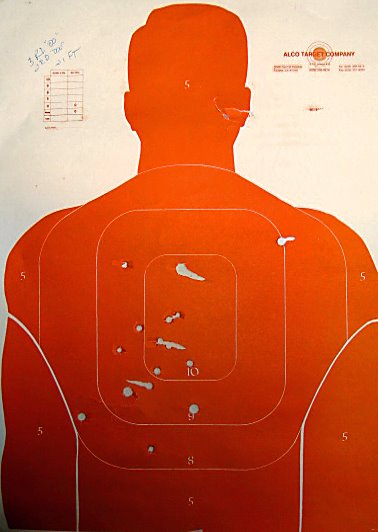
The revolver has the Taurus rubber grips which are hands-down the best revolvers grips produced today. What makes the gun strange is the elongated cylinder which is capable of handling 5 rounds of .45 Colt or .410 shotgun shells. This makes for some interesting home defense scenarios when examining the options afforded by this revolver. At first I thought that the way to go would be something like the first round containing #4 shot with the remainder loaded with the .45 Colt cartridges. The best way to look at these possiblities is to examine the targets.


Here is ten rounds of Winchester 225 grain Silvertip Hollowpoints fired at 21 feet. The accuracy is great and the cartridge is certainly capable of dispatching those who would invade your domicile to plunder and cause injury to your family. However, when shooting inside a residence one must be concerned with over penetration through your intended victim or shots going wild and breeching a wall or door and injuring a family member.

This is where the .410 shotshell provides an option. There are those who feel that #4 shot is the way to go if you are pressed into shooting inside a home. The shot is lethal at close ranges, but not likely to over penetrate or penetrate a wall or door.
Here is one round of#4 shot fired at 21 feet. The revolver was aimed at center mass and most of the shot went into the torso with 4 going into the left ear and face and six missing the target.


Here is one round of #4 shot fired at 10 feet. I realize that this is difficult to see but at 10 feet all pellets hit the torso with none missing.
Here's another option. This target shows one round with four pellets of 00 buck fired at 21 feet. Two of the pellets grouped together in the 10 ring with one close by in the nine ring and one further up in the same ring.


Here is one round of 00 buck fired at 10 feet. The four pellets have hit with in a nice line across the bottom of the 10 ring.
Here is yet another option. One round of three pellet 000 buck fired at 21 feet. The holes are larger with two in the 8 ring and one in the 10 ring.


Here is the 000 buck at 10 feet. Two pellets in the 9 ring, one in the five ring and the wad from the shell penetrated the target at the right side of the 9 ring also.
I call this last one "unleashing the hounds". It is two rounds of 000 buck and three rounds of 00 buck and the results are devastating.

I like this revolver. It is easy to shoot and provides many options for protecting your home and loved ones. Plus, it can be found for about $350.00 which makes it a home defense bargain.
Remington Model 51 .380 ACP and Colt Officers Match Revolver in .38 Special

This report contains two vintage handguns acquired from my two favorite dealers; Cliff of Cliff's Guns, Safes, and Reloading located right here in Boise (www.cliffsgsr.biz) and Sam of Sam's Guns from Pocatello, Idaho.

Remington 51
The first pistol is a fantastic little Remington Model 51 in caliber .380 ACP.


The Model 51 was manufactured by Remington from 1918 to 1927 with approximately 65,000 produced in either .32 or .380 ACP. This specimine is in about 85% condition with some fair loss of bluing on the backstrap. The main competition for this pistol was the Colt Model 1903 in .32 ACP and the Model 1908 in caliber .380 ACP. Like the Colt .380 this one also holds seven rounds in the magazine with one in the chamber. The Colts were vastly more popular and produced from the date of their model number through WWII. However, my Remington 51 is much more accurate than my Colt 1908. This may be because the Remington's grip and grip angle makes it a very intuitive pointing pistol. Gun lore states that Remington put a lot of research and development into the design of this grip and if that is true then they should be proud of the results. Why the pistol did not find the success of its Colt competitor is a mystery to me. The handgun is thin and very flat with no protrusions on any side. This pistol could be stuck in the waistband of your trousers and ride there very easily all day. In fact legend has it that General George S. Patton, Jr. frequently carried one just that way. I say legend because it is known that he carried a Colt Single Action Army Revolver in .45 Colt with ivory grips, a Smith & Wesson "N" frame .357 magnum with a 3 inch barrel and ivory grips, and a semi-automatic small caliber pistol. While it could have been a Remington 51 it was more likely a Colt Model 1903 or 1908 since they were actually issued to General Officers of the Army. There is some information to suggest that a close friend had one engraved and sent to him when he was overseas during WWII. While this may be true one has to realize that:
1. By 1941 this pistol had been out of production for 14 years.
2. It is unlikely that Patton would carry an engraved presentation piece with him during the rigors of combat and overseas duty.
3. Pictures and other documentation about his Colt Single Action Army .45, Smith & Wesson .357, and Colt Model Model 1903/1908 are quite plentiful on the internet and in reference books.

There is a lot to like about this Remington pistol but there are also a few negatives as well. Like most small pistols of the day sights were apparently thought not to be all that important since, just like the Colt models, the sights are miniscule at best. The other negative is the disassembly of this handgun. It is tough to take apart and even tougher to put back together. Last night I have given up, put all the parts in a plastic baggie and intended to take them to the gunsmith on Monday. However, I gave it one more try this morning and was successful. This alone may be the reason these pistols never caught on with the consumer.

Even though the sights are minimal the intuitive ability of this pistol to point makes it a good shooter as these targets attest. Overall this pistol was a lot of fun to shoot.

These two targets were shot at 21 feet. Twenty-five rounds were fired at the first target and seven were fired at the second.


This target was placed at 50 feet and absorbed the last 37 rounds of the shooting session.


Now I know that many of you might be reading this and saying that this is all well but you wouldn't really carry a .380 for self defense. If so, remember this: Wild Bill Hicock came out on top in seven gunfights (one supposedly at 50 yards) with a Colt Cap and Ball blackpowder revolver in .36 caliber. He put seven men in Boot Hill pushin' up daisies by shooing them with a round lead ball slightly smaller than a .380 bullet and without the ballistic enhancement of hollowpoints and higher pressure powders that we have today. Wild Bill understood the importance of accuracy. Therefore I wouldn't feel under armed carrying the Remington (and a spare magazine or two).

Colt Officers Match Revolver in .38 Special

The Colt Officers Match came out of an evolution of the Colt New Service and New Army Revolvers and were most popularly chambered in .22 long rifle and .38 Special with a six inch barrel.


This specimen is in about 65 to 70% condition, has the rarer heavy barrel and the action still locks up pretty tight. Holster wear has worn most of the bluing off of the front of the barrel and handling has removed the blue from the back and front stap. The front strap also shows evidence that the original owner wore a ring on his third finger. The grips and the rest of the gun show nicks and dings appropriate with the age of a gun that was purposefully used almost 100 years ago. However, the revolver has character. Althoug the condition is not great, you can see that in it's time, this was a "best in class" firearm. Both the metal on the backstrap and trigger are checkered and the screw on the front sight still shows the "Fire Blue" color that made these revolvers so beautiful. The rear sight is adjustable for windage and the top of the frame is flat, rather than rounded as usually seen on fixed sighted Colt revolvers. The front sight is adjustable for elevation, although I am going to have to have the gunsmith show me how this is done. The barrel is marked .38 Special DA (double action) and although the single action pull is great I found better accuracy when pulling the trigger double action. The gun shot high in single action and double action lowered it near center as can be seen below:


Target shot double action at 21 feet.


I only had one box of .38 Special with me on Saturday and expect to work this in and get better groups next weekend.
Colt Police Positive in .38 Special and Colt Pocket Positive in .32 S&W Long.

This Range Report will cover two vintage revolvers; the newest being sixty-two years old.

This week I took another vintage revolver to the range that I acquired during the winter along with a vintage revolver that I purchased from GunsAmerica.com last week.

Colt Police Positive

The top revolver is a Colt Police Position in .38 Special that was manufactured in 1906 or 1907. It is in amazingly good condition with the bluing conservatively at 95%. The hammer and trigger sport Colt’s Fire Blue and are in 100% condition. There are very few Colt Revolvers that I have seen with the Fire Bluing still on them. The hammer on this specimen shows a bright cobalt mirror finish. Because of the condition of this revolver, this was probably the one and only time I am going to shoot it. I added the Tyler T-Grip adapter to the original hard rubber grips on the Police Positive to make it easier to handle in double action shooting. Here’s how she did:

The target on the left was shot at 21 feet while the other one was at a range of 30 feet. Not bad for a gun that is 100 years old and still in completely original condition (other than the addition of the T-Grip). The Police Positive is a fairly small, lightweight revolver and the recoil of the remanufactured 158 grain lead swaged wadcutters was pretty substantial.

Colt Pocket Positive

The other vintage revolver was purchased this week from a gun dealer in Virginia off of his listing in GunsAmerica.com. The Colt Pocket Positive was chambered in the .32 Colt Police Cartridge and sported barrel lengths of 2.5, 4, and 6 inches, although a pocket revolver with a six inch barrel seems a little ungainly. They must have had really large pockets back in those days. Smith & Wesson’s version of the .32 Colt, the S&W .32 Long, contained the same 98 grain bullet weight as the Colt .32 Police. However the S&W round was in a swaged wadcutter configuration rather than a round nose. The S&W .32 Long also contained a little more powder which boosted the velocity by about 58 feet per second. This made the S&W cartridge more accurate, a little more powerful, and a lot more popular with the gun buying public. Colt continued to make the Pocket Positive up to 1947 however, ammunition manufacturers stopped making the .32 Colt Police Cartridges long before then. Colt still put this caliber marking on the barrel as they could not bring themselves to stamp the letters “S&W” on a Colt made product.

The pistol that I purchased was made in 1942, the last year of production before Colt switched to solely making firearms for the military’s use in WWII. Actually this revolver was probably assembled with parts made a year or two earlier but shipped in 1942 as by then Colt was already in full wartime production. My pistol was not in original condition, it had been reblued (although all barrel marking were still sharp and very visible) and the hard rubber grips had been replaced with newly manufactured mahogany ones. The results:

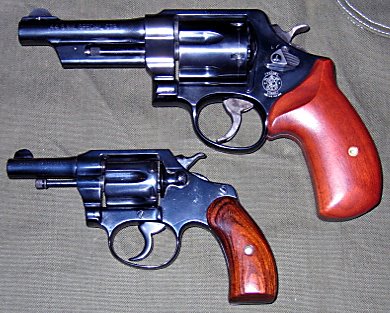
Again, the target on the left was placed at 21 feet while the one on the right was at 30. As you can see from the picture where it is placed under the Police Positive, the Pocket Positive is a very small revolver. For a more dramatic comparison I also show it under a Smith & Wesson Model 21 .44 Special. The aftermarket mahogany grips are a little more filling than the original grips would have been, but there were smooth and difficult to hold onto during double action firing. Upon coming home I went on-line and ordered a set of original Colt checkered hard rubber grips from Numrich Gun Parts. When these arrive I will add a Tyler-T Grip adapter and the handling characteristics should improve.


Bringing the Bore Back to Life

One of the difficulties of purchasing a used gun online is that you are taking the seller’s word about the condition. From the description and picture of this revolver, it appeared to be in good shape. It had been reblued and handsome grips had been put on so I trusted that she had been cleaned and anything in need of repair was fixed. However, after receiving her and looking down the barrel I did not see any rifling. Upon inserting my bore light it was there, however very shallow.

After shooting on Saturday I showed her to the gunsmith at the range. In his opinion, it was highly unlikely that this revolver had been shot enough to completely shoot-out the rifling. This little revolver is just not the type of gun that would normally see a lot of shooting time. He felt that as the gun had been reblued and had the grips replaced, it was more likely that the original owner shot the gun but never cleaned her. It was possible that the rifling could be filled up with compacted lead, powder residue and possibly some copper jacketing. This might also cause the accuracy to be less than desirable. He recommended a thorough cleaning of the barrel.

Last night I filled the barrel with Outers Foaming Bore Cleaner and let it soak in for 30 minutes. The patches came out very dirty and the rifling appeared more prominent, but still subdued. I then reached for the Hoppes Benchrest Bore Cleaner. This is fairly nasty stuff and I had stopped using it some time ago as it is strongly ammonia based which requires that it only be used in very well ventilated areas. It also burns when it makes contact with skin. In fully reading the directions it stated that if the bore required a thorough cleaning it should be saturated and allowed to sit over night. I soaked a patch, ran it through the barrel and let it sit for 15 minutes. The dry patches used afterward came out pretty black. I then soaked two more patches, ran them through the barrel and let them sit overnight.

This morning I ran a dry patch through the barrel and it came out looking like a referee’s shirt; white with very distinctive black lines on it, the black lines being the exact width of the rifling. Now in looking down the barrel the rifling is much more prominent. I will be interested the see how the replacement grips and the clean rifling affect the accuracy of this little gun.
Big Bore Revolvers

In this week’s Range Report we look at three big bore revolvers. All three are capable of handling just about anything that you might run into here in Idaho; Elk, Moose, Lions, Rotarians, Free Masons, and the occasional Shriner.

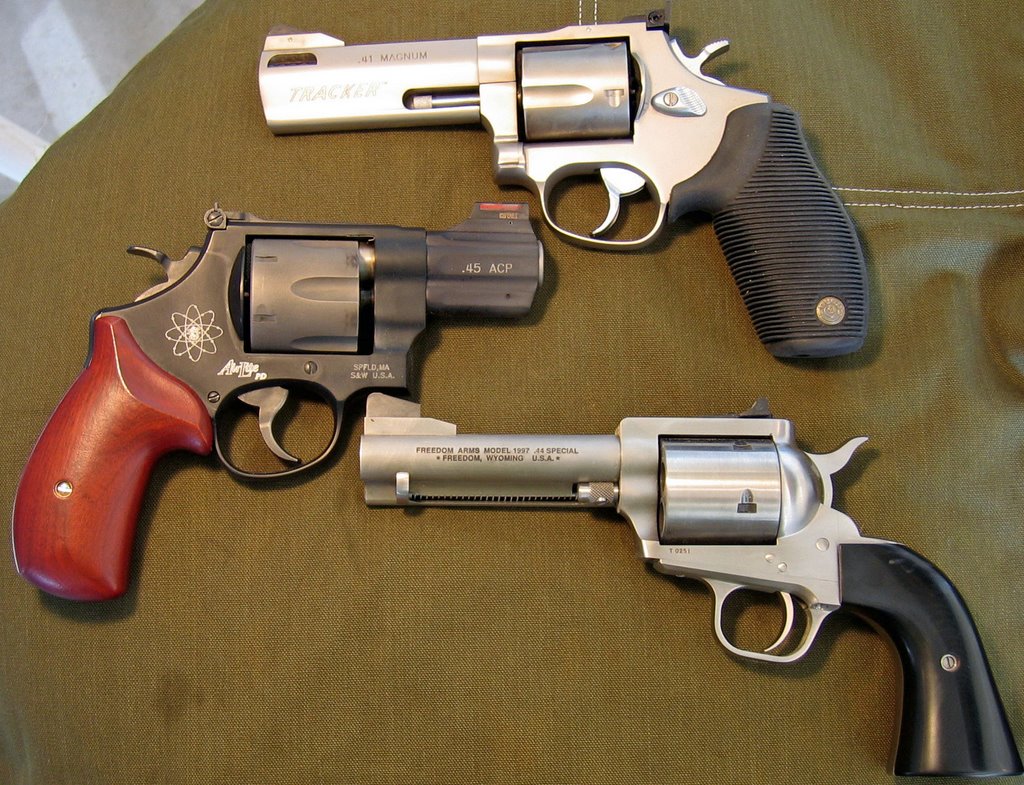
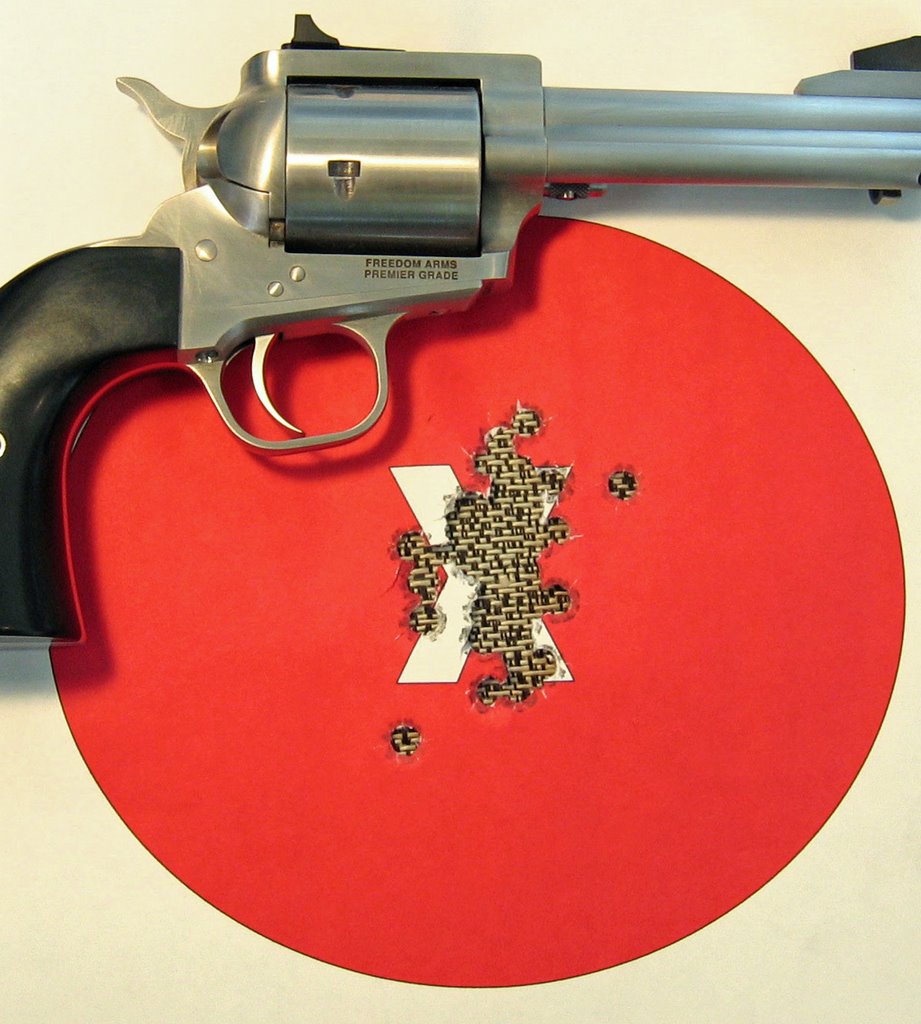
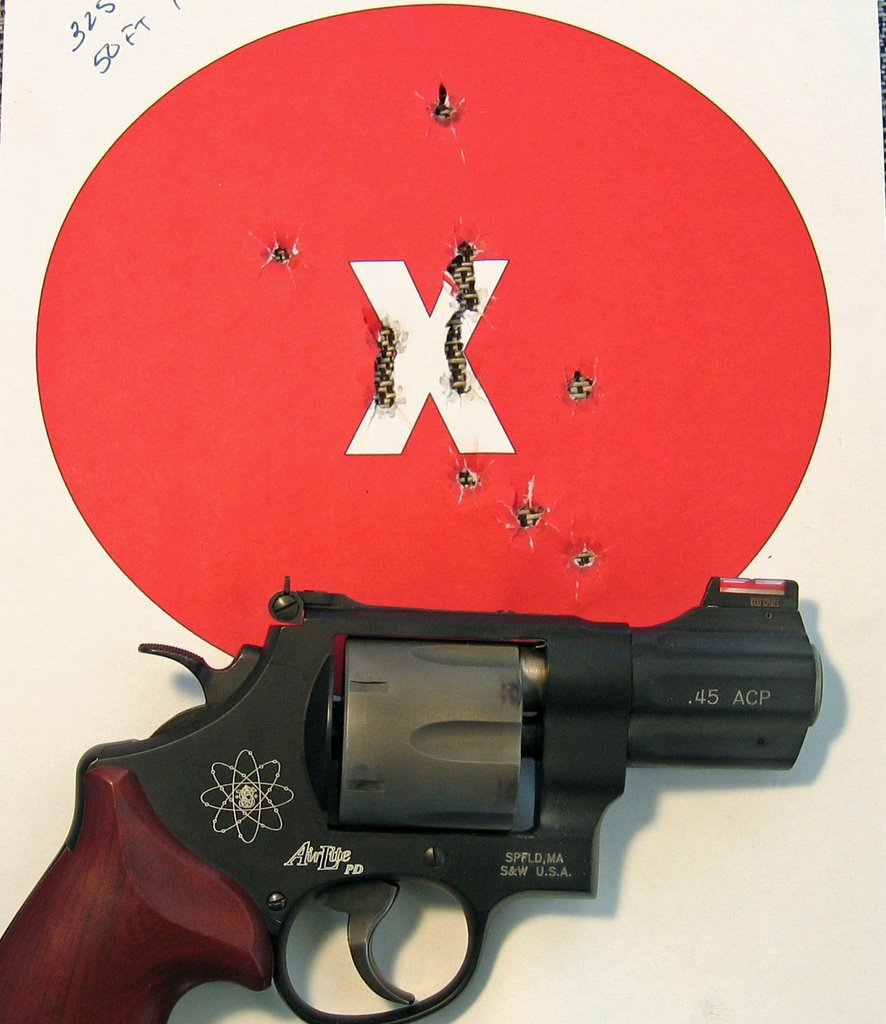
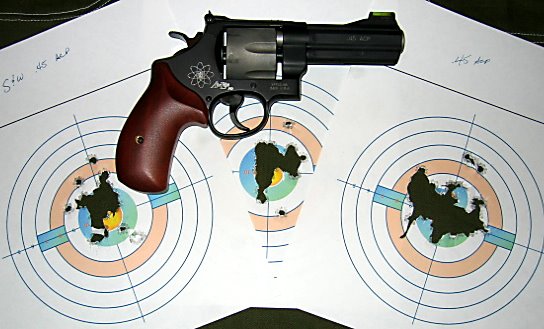
The three blasters we shot today were (from top to bottom) The Taurus Tracker in .41 Magnum, The Smith & Wesson Model 325 PD with a 2.5 inch barrel in .45 ACP, and the Freedom Arms Premier Grade .44 Special with a 4.25 inch barrel.


Why all the revolvers? First of all it seems in today’s day and age with high capacity polymer pistols being all the rage it is important to remember how accurate revolvers can be right out of the box. Revolvers do not need any break-in period, there are no safeties to hassle with and they can be fired double action for fast defensive work or single action for slow precision shooting (in the case of the Freedom Arms revolver, single action only), they don’t eject brass all over the place and, with practice, can be loaded very quickly.

Freedom Arms Premier Grade .44 Special
Freedom Arms revolvers are obvious copies of the various Colt single-action revolvers of the cowboy era. This model comes with a 4.25 inch barrel, a capacity of 5 rounds of .44 SPL, adjustable sights, ebony micarta grips and the most beautiful stainless steel finish you are likely to see on any handgun. Freedom Arms revolvers are handmade and the artisans in Freedom, Wyoming make every part of this revolver right down to the screws. Freedom Arms revolvers are also quite difficult to come by however, Sam, of Sam’s Guns in Pocatello, Idaho, always has a pretty fair line-up of Freedom Arms stock on hand. It may be difficult to determine which one I will want next, but it was not a problem to choose my first one. I had been coveting this revolver for the past 3 gun shows. The weight, balance, and action are all perfect and the adjustable sights are easy to regulate. This revolver is accurate and an overall pleasure to shoot.
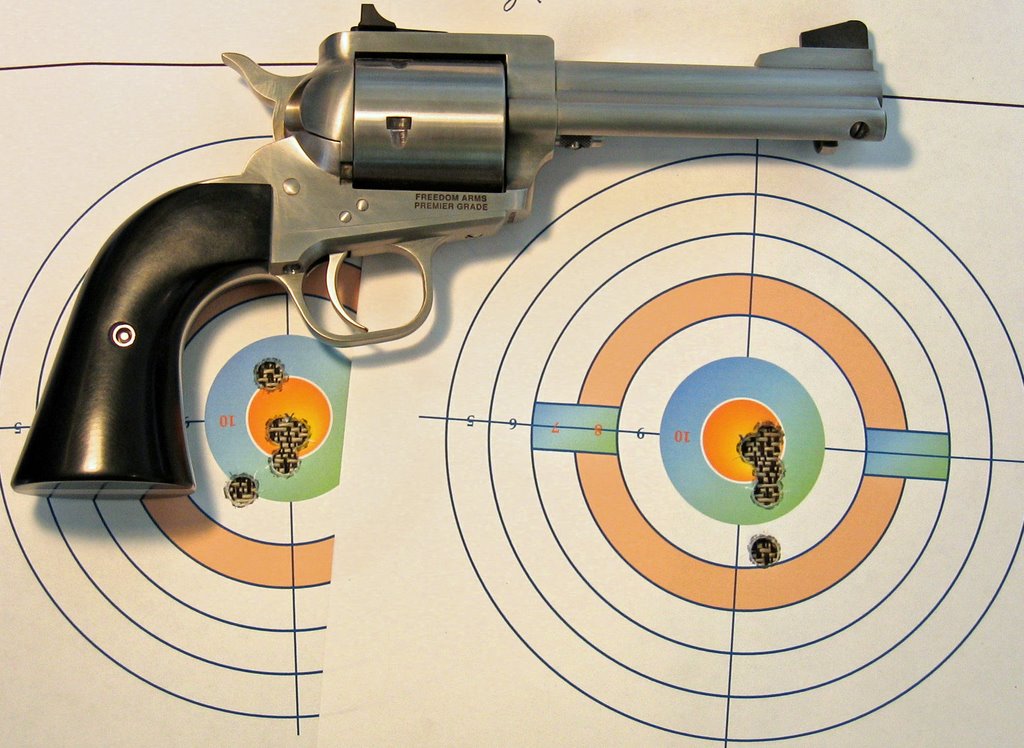
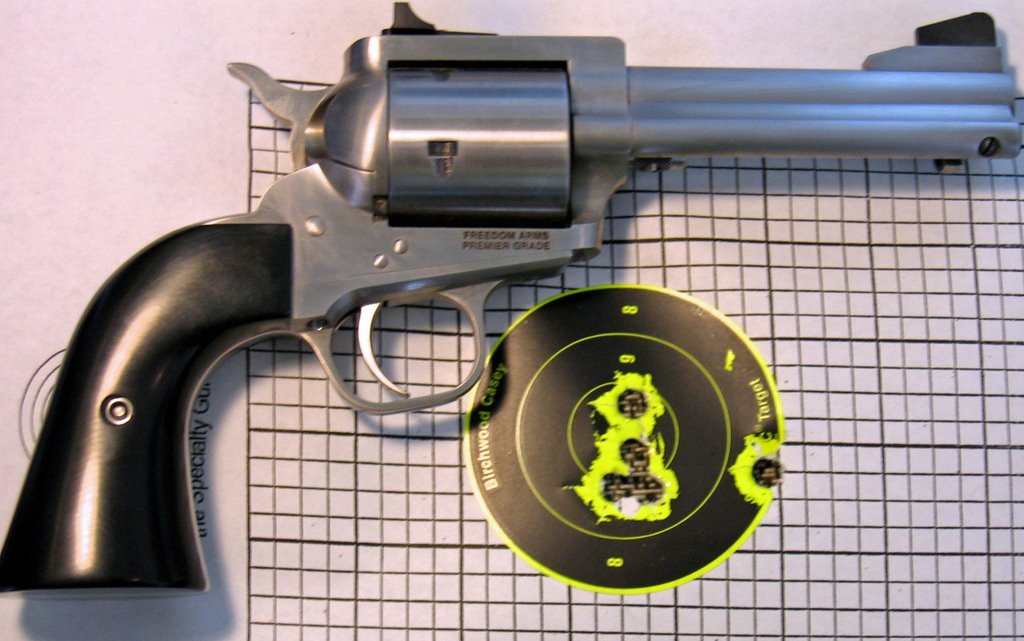
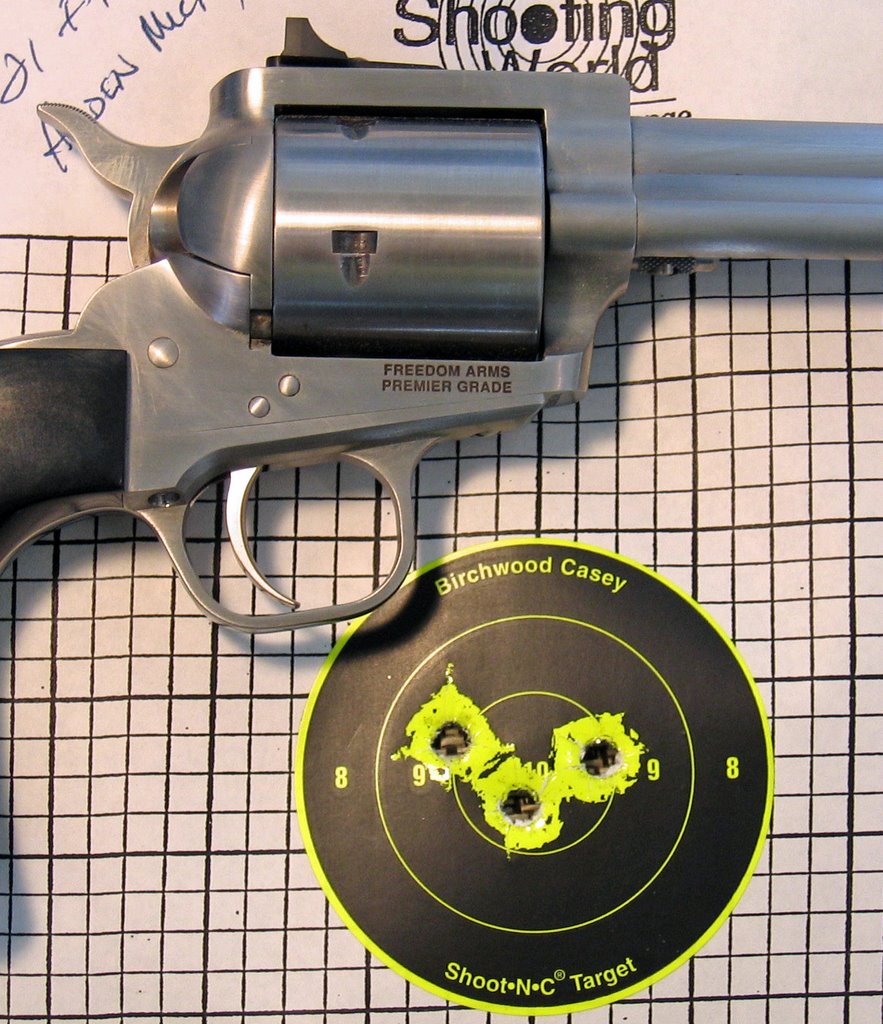
Targets 1, and 2 are 5-shot groups from 21 feet. Target 3 is three rounds from 21 feet and, for those who are Disney fanatics, find the hidden Mickey in this picture. Target 5 is an attempt to shoot the “X” out of the target at 21 feet (the only problem was that the bullets kept going through the same hole).

.

Smith & Wesson Model 325 PD .45 ACP with a 2.5 inch barrel
This is another revolver that is a little difficult to come by, but again Sam in Pocatello is very resourceful, and this gun had several surprises in store for me. The 325 PD is a scandium frame, lightweight revolver. It has adjustable sights, the front being a hi-viz bright orange fiber optic sight.

Here’s the first surprise, a revolver this small and this lightweight in .45 ACP has to have horrific recoil, right? Wrong, this little blaster was actually fairly easy to handle.

Second surprise, a revolver this small and lightweight in .45 ACP cannot be very accurate, right? Wrong!

Targets 1, 2, and 3 were 12 rounds each fired at 21 feet. Target 4 is 12 rounds at 50 feet. This revolver has the practical accuracy to meet all of your defensive needs.

Third surprise, revolvers don’t jam, do they? Wrong! On my second cylinder full of Independence .45 ammo, the cylinder locked-up after firing the second round. The culprit was ammunition where the bullet had not been properly crimped into the brass. When this little revolver takes the shock of having .45 caliber explosions going off the bullets began coming unseated from the brass, causing them to stick out of the cylinder and causing the upcoming round to bang into the forcing cone. This happened to six rounds of the Independence ammo out of the first 18 cartridges causing me to discard the rest of the box. This then occurred with one CCI Blazer round out of a box of 50. I am happy to report that it did not happen at all with Mag-Tech and Winchester white box. I have used the Independence ammo quite a bit in my semi-automatic pistols and it would appear that the magazine holds the round tightly in place and do not allow for the bullet to become unseated.

On the left is a properly seated and crimped Mag-Tech round, followed by 3 rounds of the unseated Independence ammo and one round of the CCI Blazer. You can easily see how the bullets have worked themselves out of the casing and you can also see the crimp line on the three Independence rounds.

The moral of this story is easy. Always buy well-made ammo. Quality does not have to be sacrificed when looking for the lowest price.

Taurus Tracker in .41 Magnum

The Tracker is a stainless steel revolver with a 4 inch ported barrel, adjustable sights, 5 shot capacity, and probably the best factory grips ever put on a handgun. The front sight has a red ramp and the rear sight is outlined in white. The .41 Magnum is a potent cartridge, but not unmanageable.

The first target is 10 round fired at 21 feet and the second target is 15 rounds fired at 50 feet.


<>
.22 Round-Up

When I say this is a round-up that does not mean that this is an exhaustive look at .22 handguns, it merely means that I rounded up all of the .22’s in my safe to see how they stack up in terms of price, handling, and function. Let’s start with the least expensive.

Phoenix Arms HP 22


The Phoenix Arms HP22 is a sheep in wolf’s clothing. By this I mean that it is a very inexpensive pistol trying too hard to market itself as a target pistol. When I bought this .22 way back in 1991 I think I paid something like $69.00 for this pistol which included the regular and target barrel and two magazines (one of them with a finger extension on the bottom). Now it’s going to a little more than twice that and while it’s still economically priced, pleased don’t have any illusions that it is a target pistol. You are getting what you pay for. I found no difference in accuracy between the regular, short barrel and the 5 inch target barrel. However, even though I find no accuracy difference, I keep the target barrel on the pistol just because I like the way it looks.

All .22’s in this test were fired from a range of 21 feet.

OK, let’s examine the negatives of the HP 22 and really these are more complaints about truth in advertising that actual complaints about the pistol:


The gun is advertised as being very safe by virtue of having 2 manual safeties; a firing pin safety located on the left rear of the slide, and a magazine safety located at the top of the left plastic grip panel. In actuality these safeties are a pain in the butt. Two manual safeties is one too many!


The pistol is easy to disassembly, but difficult to assemble. I have spent a lot of time looking for the recoil spring which has a tendency to jump out of the fame when you begin to compress it as you re-assemble the gun. Once when reassembling the gun I got the spring so bent and twisted that I had to send the pistol back to the factory. The good news is that they fixed it free of charge.


The gun is advertised as having target sights with the rear sight being adjustable for windage. In reality the sights are small and the accuracy of the gun is such that it is difficult to make a meaningful adjustment of the rear sight when you cannot get a grouping big enough to assume that the pistol is shooting to any particular spot on the target.
Lastly, the name “HP 22” sounds like a home office printer, not a firearm.

For the positives:
The pistol works. It always goes bang when you pull the trigger and I have not found it to be particularly ammo sensitive.
It is light weight and, even with the 5 inch barrel, it is compact.
It is comfortable to shoot.

The bottom line: This is a single action only gun with a decent trigger pull. If you need an inexpensive plinker this is a good deal however, don’t fall under the misconception that it is a target pistol.


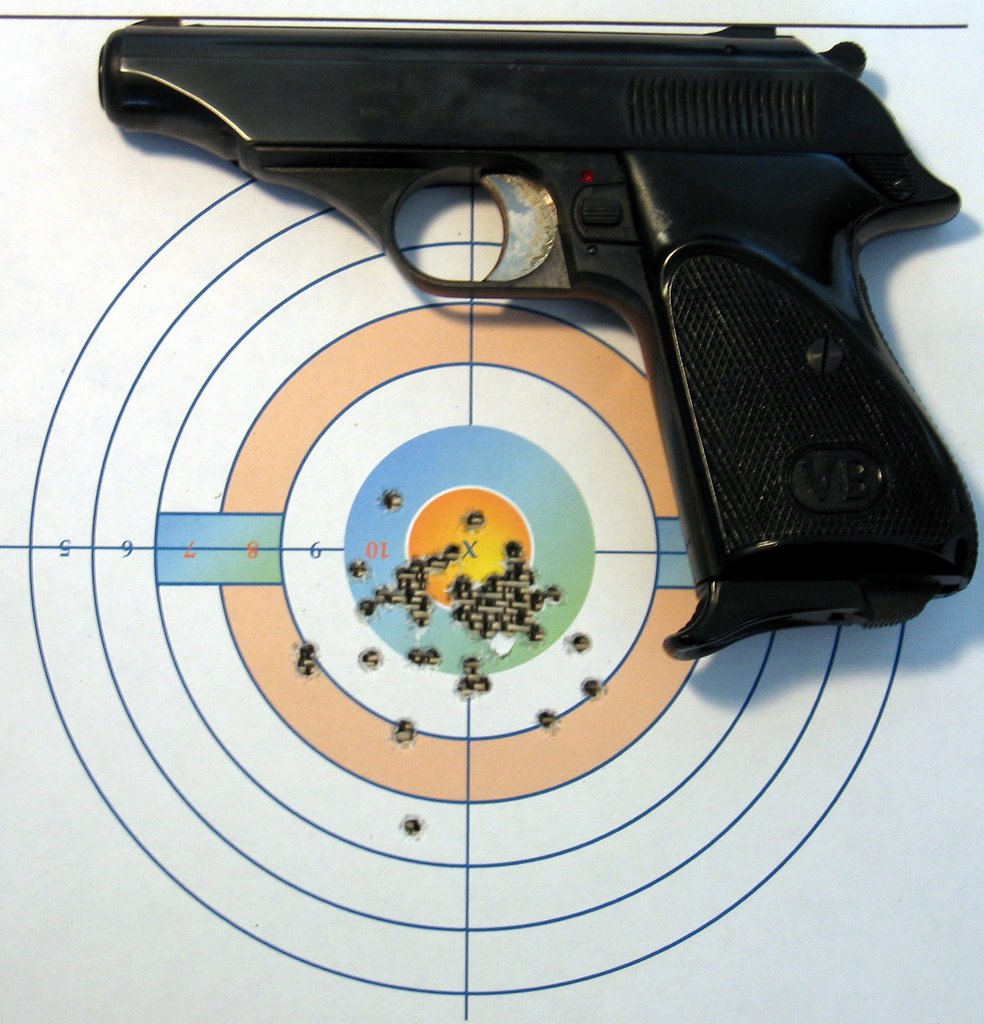
Bernadelli 74
This little pistol is something of a mystery, a UFO (undocumented firing object). According to the Blue Book of gun values it was never imported into this country. This is interesting since I have seen two others in .380 ACP (and wished I had snapped one up). Somehow they show up and this specimen, which set me back $200, was in excellent condition.

This pistol is heavy, and the black plastic grips fit my hand very nicely. The sights are small but useable. This is a single action only pistol and trigger has a little bit of pull with a nice crisp release.

The bottom line: I like this pistol. It is heavier than the Phoenix HP 22 but is more accurate, more ergonomic, and a lot more fun to shoot.

Beretta 85
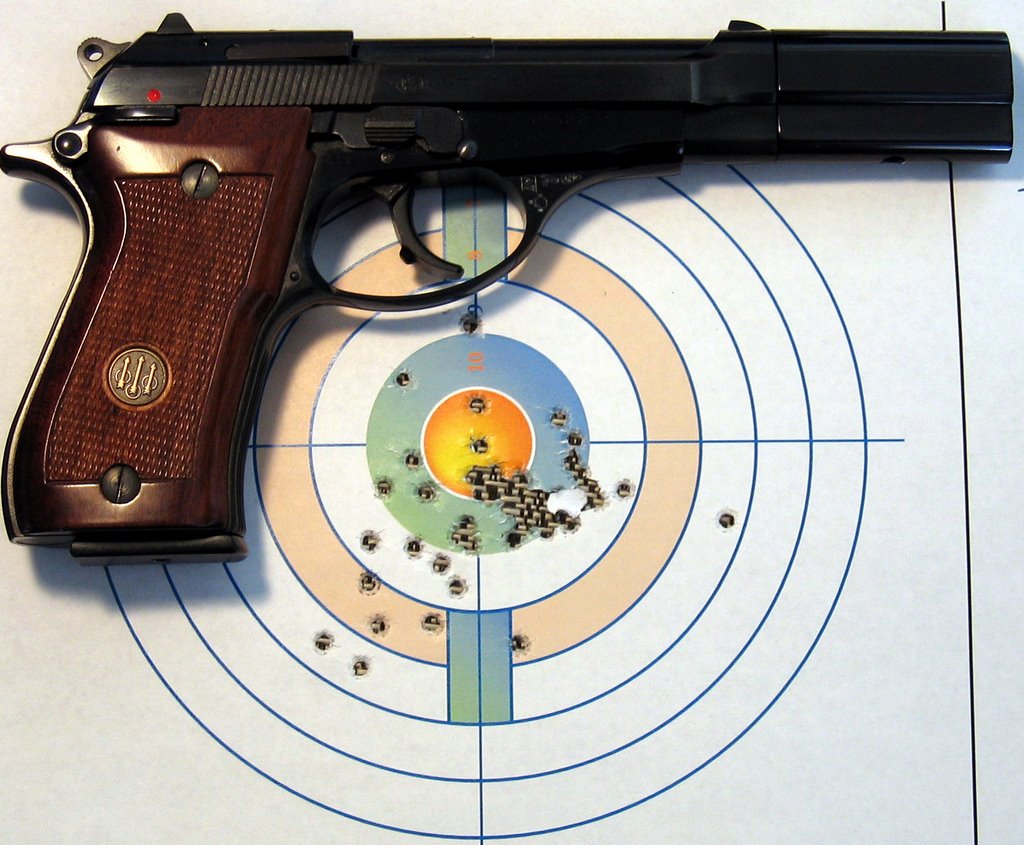
This is a very cool pistol. I found it at Sherwood International in Northridge, California in about 1988. It had been a special order and the customer never picked it up. This model has a six inch weighted barrel that the attendant at more than one gun range mistook as a silencer. Although it has a target barrel, it does not have adjustable target sights and does not deliver target accuracy. It is however, fun to shoot and you can be sure that you will be the only one at the gun range with one.
As you can see from the target, it doesn’t shoot even as well as the smaller Bernadelli, but it is a very cool gun (and reportedly was favored by Israeli assassins for its low report). The Beretta 85 is also a single action only pistol and has a good trigger pull with a moderate amount of creep before let off.


Kimber Rimfire


I have written about this gun before. It is a full size .45 Government Model with a .22 hidden inside. It is very lightweight and packs more than enough accuracy for a .22. It has very comfortable rubber grips and adjustable target sights. I can find no faults with this pistol.

CZ Kadet

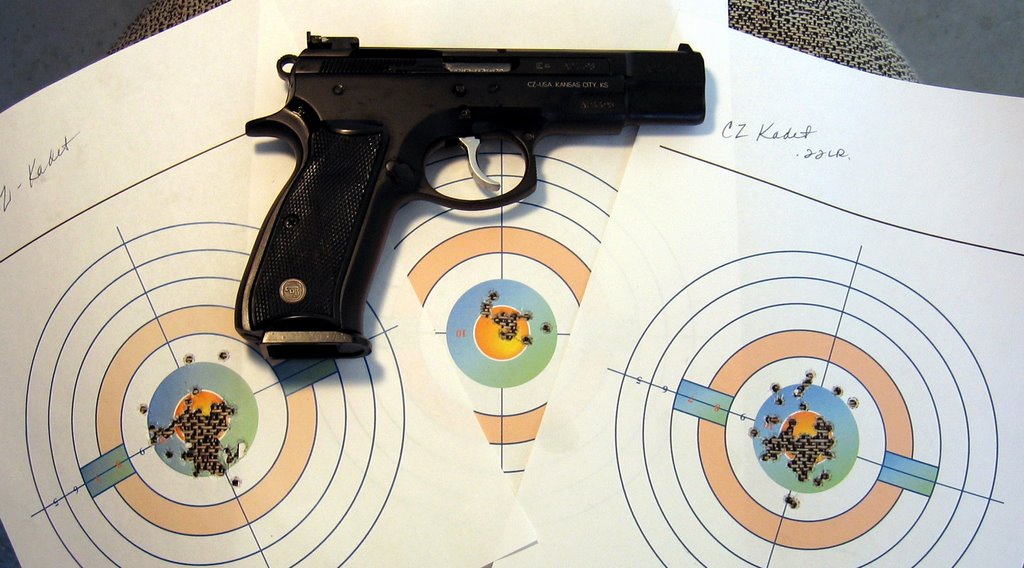
Like the Kimber Rimfire, the CZ Kadet is a full size 9mm that swallowed up a .22 pistol however, unlike the Kimber the Kadet is not a lightweight pistol. It has the same feel and weight as the full-size CZ but also has adjustable sights (which so far have not needed much of an adjustment). This pistol is also single action only with a light target trigger. The Kadet runs brand new at and even $400.00 and is accurate enough that, if serious, you could probably use it in rimfire competitions.

Vintage Range Report:

As most of you know, our shooting range was closed from December until the 3rd week of March, during which time new ownership took over. This left my normal Saturday morning shooting time wide-open. This allowed me the opportunity to peruse local gun shops and gun shows looking for vintage Colt and Smith & Wesson double-action revolvers. At first this search was very disappointing, not that the vintage models in acceptable to fine condition were not available, in fact they are. The problem that arose was price. If one was to find a good specimen of a Smith & Wesson triple-lock or a Colt New Service revolver, and I found many, you were generally looking at $800 to a grand for a shootable, but very used gun. Triple-locks and New Service revolvers with most of their original finish and sharp, uncracked grips ran in the neighborhood of $1200 to 2 grand. Finally another collector clued me in that, if I were to look at revolvers in some of the more unpopular calibers, acceptable pricing could be found. As I began to look, I found that vintage revolver in .22 Long Rifle, .38 Special, .44 Special, .44-40, .45 ACP, and .45 Long Colt commanded the highest prices. While revolvers in .32 S&W Long, .32 Colt Police, and .38 Smith & Wesson, tended to languish on dealer’s shelves and on gun show tables which brought their prices down.

That brings me to the three finds, two from gun shops and one from a gun show.

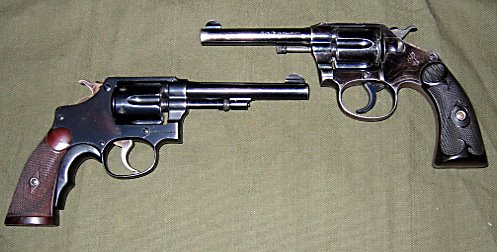
Let’s start with two revolvers. The Colt Police Positive in .32 Colt Police (upper right) and a Smith & Wesson Hand Ejector in .32 S&W Long (lower left):


Your first question might be what is the difference between the .32 Colt Police round and the .32 S&W Long cartridges? The answer is: Nothing. They are exactly the same round. Smith & Wesson developed the cartridge first and began marketing it for personal protection, small game, and law enforcement. Colt realized that they needed to catch up so that produced their own revolver, aimed at police sales and dubbed it the Police Positive in .32 Colt Police. It is unclear whether Colt was afraid of a lawsuit if they claimed to use the same round or if they did not want Smith & Wesson’s name in their advertisements, but the result is the same; the rounds are interchangeable.

Colt Police Positive

Both of these revolvers were born in the days before the beginning of the last century. The Police Positive was adopted by New York City Police Commissioner Theodore Roosevelt as standard issue to the NYPD. Prior to Roosevelt police officers supplied their own firearms in whatever caliber they wanted. Also, there were no formal firearms training standards. The story goes that Roosevelt decided to change all of this after two officers were trying to shoot a mad dog and wound up hitting quite a few civilian bystanders who came out to see what all the shooting was about. After quick research and testing Roosevelt settled on the Colt Police Positive in .32 Colt Police. He made his decision based upon his personal finding that the revolver was superior in the accuracy department.

I found this Police Positive collecting dust on the shelves of the Boise Gun Company for the princely sum of $179.00 (compared to a Colt New Service revolver in .38-40 caliber next to it with almost no original finish and priced at $900.00). It is difficult to see from the picture but the gun only retains about 50% of the original bluing and virtually none on the backstrap. While this specimen must have seen some pretty good use, the cylinders locked up tight and the bore was in excellent condition. The small front sight is very thin and the rear sight very narrow and shallow. I was concerned about the ability to accurately and consistently place shots from this pistol. The target below was shot double action (fairly slow-fire) from 21 feet using 6 Federal Classic 98 grain Lead Round Nose bullets.

Conclusion:

I always thought that TR was a great leader and great politician. He was also undoubtedly also a great police commissioner because he was certainly right about the accuracy of this revolver and the .32 ammunition.


Six rounds at 21 feet


The Federal ammunition was the most accurate I fired from both revolvers; however the cases expanded in the chambers, many of them cracking. It took quite a bit of effort to eject the fired cartridges.

This little revolver is serial number 1270005. The dealer told me this meant that this was the 5th revolver produced in Model #127 which was the Police Positive. If that is so, then this is a very old specimen. Perhaps this was one of Roosevelt’s test guns.

Smith & Wesson Hand Ejector in .32 S&W Long

The Smith & Wesson Hand Ejector got its name due to the fact that this was Smith & Wesson’s first swing open cylinder which used your hand to push the ejector rod to dispel the cartridges. Prior to this model Smith & Wesson handguns were of the break-top variety which automatically pushed the shells out as you opened the revolver.

This specimen is in much better shape than the Colt. Most of the original finish is intact except for a little wear at the front of the barrel and some very minor pinpoints of rust on the backstrap and right side of the frame. 99% of the rust was easily removed Outer’s Rust Remover. This was a gun show find and, due to condition cost almost twice as much as the Colt. The seller also had a Hand Ejector in a slightly more used condition chambered in .38 Special for $749.00. I added a Tyler T-grip adapter to the gun, not because of recoil, but because it made the grip more comfortable to hold while allowing the gun to retail it’s classic profile. I will add one to the Police Positive soon.

How does it shoot?

The sights are just a little better than the Colt. I fired this revolver with Mag-Tech’s 98 grain semi-jacketed hollowpoint ammo with the following results:

This was 12 rounds fired double-action at 21 feet using a more rapid rate of fire.


While the .32 long ammunition is certainly not a high-power round, it was very popular in its day. Back in the early part of the last century, your other choices would have .38 Special, .44 Special, .45, .38-40 and .44-40. At the time the .38 Special Lead Round Nose ammo was similarly anemic while the other rounds were difficult for some people to handle (the .38-40 and .44-40 were actually rifle cartridges).

So what you lost in power you picked up in accuracy, which is not at all a bad thing.

Browning Model 1910 in .380 ACP

I am a big fan of the Colt Pocket Hammerless pistols (designed by John M. Browning) especially in .380. I currently own one example from each caliber (.25 ACP, .32 ACP, and .380 ACP). However a Pocket Hammerless in .380 that is still in good shape will run upwards of $800.00). Therefore I was very interested when I found this Browning Model 1910 .380 ACP in very good condition for just a few dollars under $300.00. The pistol was produced from 1910 to 1972. In 1968 Browning had to add adjustable sights, grips with a right side thumb rest and a magazine extension in order for it to qualify for importation after the Gun Control Act of 1968. As my pistol has these features it is obviously a later production model. The “claim to fame” of the Model 1910 is that it was the pistol that started World War I. The Browning 1910 was used by a Serbian assassin to kill Archduke Franz Ferdinand of Austria.

The model 1910 is large and heavy compared to .380 caliber pistols on Today’s market. However this specimen did not shoot well, despite adjustable sights, it kicked like a mule, and the grip safety, backstrap and slide release were sharp and bite the web of my hand. Somehow Browning was able to take this heavy pistol and make it kick like a .45 ACP.


Browning 1910 shot at 21 feet


To sum up; uncomfortable to shoot and inaccurate, however if you think this pistol is kind of cool, it will be in the used gun case at Cliff’s Guns, Safes, and Reloading in Boise by next Saturday. Cliff does advertise on Guns America.com and ships UPS.

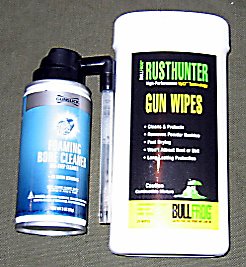
Lastly I would like to share two good cleaning products with you. Outers Foaming Bore Cleaner and BullFrog Rust Hunter Gun Wipes. The Foaming Bore Cleaner is the best product that I have found for removing lead, powder, and most importantly copper fouling from pistol barrels. The Gun Wipes are a very convenient product and do a great job of cleaning the grime off of the rest of my revolvers and semi-auto pistols. The Gun Wipes do state however that they should not be used on wood or plastic, so you Glock toting polymer princesses be warned, these wipes are only for men who pack real steel.
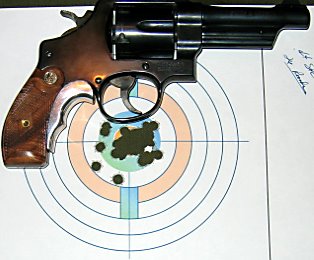
S&W Model 22 in .44 Special and Model 325 PD in .45 ACP

Big Bore Blast Off

As I mentioned at the beginning of the pocket pistol review if you know that a determined pursuer is coming after you, you want a gun whose caliber begins with a “4” (a 12 gauge with buckshot would be a good idea too). Let’s look at two:


I have written about the first one in the last two reviews, the Smith & Wesson Model 21 in .44 Special. I am writing about it again because I like shooting this gun a lot. It is powerful, but not personally damaging to shoot and it is accurate. What’s not to like? Also, since last week I have replaced the modern Aherns wooden grips with a set of vintage service grips available from Smith & Wesson online. The vintage grips give it more of an “Indiana Jones” appearance as the revolver now looks like the one he packed in the first movie and used in the Egyptian marketplace to shoot the large, black attired, sword wielding assassin. (A little movie trivia here: Harrison Ford was suffering from dysentery and de-hydration on the day that scene was shot. He was supposed to have a long, elaborately choreographed whip versus sword fight with this man, but by the time he had filmed the part where he dispatched the half dozen or so henchmen, he was too fatigued to continue. Therefore they replaced the fight scene with a more logical improvisation by having him present the big Smith & Wesson Triple lock revolver from its flap holster and put a fat slug into the would-be assailant).

The picture does not due it justice but these checkered grips are really beautiful.


And lastly, the Smith & Wesson Model 325PD in .45 ACP. This large revolver is another Scandium framed handgun with titanium cylinder, stainless steel barrel insert and red Hi-Viz sight. It weighs in at 26.5 ounces although this massive “N” frame revolver feels lighter. This would make a great “walk in the woods” gun. It is definitely a handful of recoil when you shoot it, however good accuracy is still possible as evidenced from the targets below.